
Investing in the Goa real estate market has transitioned from a simple vacation purchase into a major financial and legal commitment, driven by remote-working professionals from metropolitan cities like Mumbai and Bangalore, alongside global NRI investors. However, navigating Goa’s property market is radically different from most Indian states due to a highly complex convergence of historical Portuguese colonial jurisprudence, modern Indian statutory laws, and rapid digital transformations. Whether you are looking at a beachside villa in Candolim or a plot in Siolim, your investment’s absolute security depends on a technical and legal understanding of specialized revenue records and localized zoning regulations.
The primary authority responsible for preparing, maintaining, and updating cadastral survey records in the state is the Directorate of Settlement and Land Records (DSLR), operating under the statutory framework of the Goa Land Revenue Code, 1968. DSLR handles property mutations, subdivision/partition orders, re-surveys, and boundary demarcations. Before executing any real estate transaction, understanding how to retrieve, verify, and cross-reference these official land records is your most critical line of defense against title defects, environmental violations, and long-term litigation traps.
What are Goa Land Records? (Overview & Essential Forms)
Goa’s digital land administration divides properties based on geographical classification and urban promulgation. Land survey records serve as the definitive technical blueprints of a property, providing scaled physical maps, boundary demarcations, and legal ownership details. To perform thorough due diligence, buyers must understand the specific legal functions of Goa’s primary land record instruments: Form I & XIV, Form D, Form III, and Form B.
Form I & XIV: The Rural Land Register
For rural, non-promulgated land across Goa’s two districts, Form I & XIV (pronounced Form One and Fourteen) is the primary Record of Rights (RoR) It is the Goan equivalent of Maharashtra’s 7/12 extract. This document compiles two distinct historical records into a single sheet:
- Form I (Index of Holdings): Captures the technical identity of the land, including the Taluka, Village, Survey Number, and Sub-Division Number. It records the total cultivable and uncultivable area (measured in hectares, ares, and square meters) and classifies the soil and crop types (such as Rice, Khazan, Ker, or Morad).
- Form XIV (Record of Rights, Tenancy, and Cultivation): Focuses on legal and possession rights. It names the current registered occupant (the legal owner), documents any agricultural tenants registered under the Goa, Daman and Diu Agricultural Tenancy Act, 1964, and lists “Other Rights”—including registered easements, bank mortgages, and active legal encumbrances.
Under Section 105 of the Goa Land Revenue Code, 1968, every entry in the Record of Rights carries a statutory presumption of correctness. This means any name listed in the tenant or occupant column remains legally binding and carries permanent legal possession rights until officially altered or removed by a competent court order. Furthermore, a critical operational reality in Goa is that the seller’s name in Form XIV must match their official title deeds exactly, letter-for-letter. A single spelling variation, Konkani-English transliteration discrepancy (e.g., Borges versus Borgeskar), or an unrecorded maiden name will immediately block mutation at the Mamlatdar’s office and freeze subsequent transactions at the Sub-Registrar.
Form D: The Urban Property Card
Once an urban area in Goa undergoes a formal city survey and is officially promulgated, Form D (the Urban Property Card) replaces Form I & XIV as the legal Record of Rights. Form D is maintained by the City Survey Office (CSO), with major offices located in Panaji, Margao, Mapusa, and Vasco.
Instead of rural survey numbers, Form D identifies urban plots using a two-tier coordinate system:
- PT (Panel Town) Sheet Number: The specific master grid sheet maintained at the City Survey Office that covers that municipal sector.
- Chalta Number: The unique, pinpoint plot identifier assigned to a specific parcel within that PT Sheet.
Form D records the owner’s name, registered municipal area, exact boundaries, and any registered encumbrances. It is a non-negotiable bank requirement for securing home loans or mortgages against urban properties. Furthermore, Goa RERA strictly mandates a valid Property Register Card (Form D) for registering any new real estate development within municipal limits to prevent fraudulent developers from listing unauthorized projects. If a seller produces only a rural Form I & XIV for a property located deep inside urban Panaji, Margao, Mapusa, or Vasco, they are accessing the wrong register—often to conceal historical, un-promulgated tenant claims or outstanding municipal tax charges.
Form III and Form B: Subdivision and Partition Records
When parent land parcels are physically divided among co-sharers or subdivided into gated community layouts, Form I & XIV and Form D alone are insufficient to establish a clear legal trail of ownership. Buyers must pull and reconstruct the complete subdivision trail using Form III and Form B:
- Form III: Serves as the official record of partition orders, mutation entries, and technical demarcation reports for rural land. It compiles the underlying judgments and formal orders of the Deputy Collector and Sub-Divisional Magistrate (SDM) that legally authorized the split. It details which specific co-sharers and legal heirs were heard during the partition hearings to ensure no family members were illegally excluded.
- Form B: Serves as the urban equivalent issued by the City Survey Office. It is a certified urban survey plan showing the exact physical subdivision lines, boundary measurements, and dimensions of Chalta-numbered plots.
If you are buying a subdivided plot, you must trace these documents back to the original parent survey parcel. This step is vital to ensure that the partition was technically completed on the ground through an official on-site survey by an Inspector of Survey and Land Records (ISLR) surveyor. Buying a subdivided plot where the partition order exists on paper, but the formal ISLR demarcation report was never executed (or the survey fees went unpaid), means the plot has no legally enforceable boundary on the ground.
How to Search and Download Goa Land Records Online (Step-by-Step)
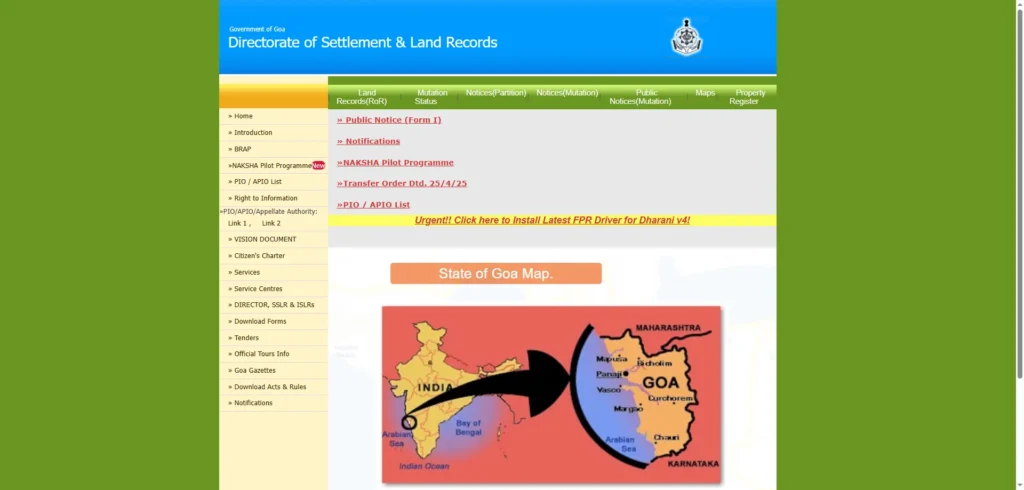
The Government of Goa operates two distinct online databases for land record retrieval. To avoid falling victim to online scams, landowners and buyers must understand the operational boundary between the DSLR Portal (for informational previews) and the Goa Online Portal (for legally valid, digitally signed copies).
Quick Informational Preview on DSLR Portal
The DSLR website is designed for rapid, free-of-cost search and informational verification.
- Visit the official DSLR portal at dslr.goa.gov.in.
- For rural properties, select the Form I & XIV tab. Choose the District, Taluka, and Village from the dropdown menus, then input the Survey Number and Sub-Division Number.
- For urban properties, select the Form D tab. Choose the City, PT Sheet Number, and Chalta Number.
- Enter the captcha security code and click View Details.
- The system will display the Record of Rights on your screen.
Critical Warning: The DSLR portal displays a prominent warning that these records are strictly for informational purposes only. They are not legally certified, do not carry a digital signature, and are routinely rejected by nationalized banks for loan sanctions and by courts of law as primary evidence of title.
Fetching Digitally Signed Certified Copies on Goa Online Portal
To obtain a legally valid, certified, and digitally signed document, you must use the state’s unified public services portal.
- Navigate to the official state portal at goaonline.gov.in.
- Register a citizen account using your legal name, mobile number, and email ID, followed by mandatory Aadhaar-linked OTP verification.
- Once logged in, go to the Services menu, select Revenue Department, and choose the specific service required: Form I and XIV, Form D, or Form III.
- Fill out the application form by selecting the District, Taluka, Village, and specific land parcel identifiers.
- Make the mandatory online payment through the integrated secure payment gateway using UPI, Debit/Credit Card, or Net Banking.
- Under the statutory timelines mandated by the Goa (Right of Citizen to Time-bound Delivery of Public Services) Act, the concerned Mamlatdar or City Survey Officer must verify and issue the digitally signed PDF to your portal inbox within two working days.
Checking Mutation Status (Namantaran) in Goa
Property mutation (Namantaran or Hakkache Patra) is the formal administrative process of updating the registered owner’s name in the land revenue records after a transaction. While a registered Sale Deed transfers civil title, only a closed and certified mutation entry completes the transfer in the eyes of the Revenue Department. It ensures that subsequent land tax assessments are issued under your name, and that Form I & XIV or Form D officially reflects your ownership.
Tracking Mutation Status Online
If you have recently registered a property, the Sub-Registrar is legally required to transmit the registered deed to the Taluka Mamlatdar within three days of registration. To track the progress of your mutation:
- Visit dslr.goa.gov.in and select the Mutation Status link.
- Select your category: Rural (Form I & XIV) or Urban (Form D).
- Select your Taluka and input the unique Mutation Transaction Number provided during your application or sent via SMS.
- Enter the captcha code and click View Status. The portal will display the applicant’s name, request date, current stage of verification, and the final certification date.
The Double-Register Risk (Manual vs. Digital)
A massive legal and procedural risk in Goan real estate is the divergence between parallel registry systems. Goa operates a dual land-record registry:
- The Digital DSLR Database: Accessed online via the DSLR and Goa Online portals.
- The Manual Taluka Register: Handwritten physical ledger books kept at the local Talathi’s office or Taluka Mamlatdar archives.
Due to administrative backlogs, data entry lags, or digitization glitches, mutations certified in physical files are often not updated in the digital database. Gaps of 12 months or more between physical orders and digital updates are common.
Worse, the digital register can occasionally show “clean” ownership due to insider manipulation or data errors, while the manual ledger contains handwritten objections, pending family partition disputes, or active agricultural tenancy claims. The manual paper ledger is the ultimate legal source of truth in a court dispute. Therefore, secure due diligence dictates that you or your lawyer must physically visit the Taluka Mamlatdar office, pull the physical village register (Hakkache Patra ledger), and manually verify the handwritten entries, boundary notes, and signatures against your digital copy before releasing any funds.
The NAKSHA Pilot Project: The Future of Urban Land Mapping in Goa
The land records system in Goa is undergoing significant administrative and legislative modernization. The most far-reaching digital initiative currently underway is the National Geospatial Knowledge-Based Land Survey of Urban Habitations (NAKSHA). Rolled out under the central government’s Digital India Land Records Modernization Programme (DILRMP), NAKSHA is being executed by the Department of Land Resources (DoLR) in close coordination with DSLR Goa.
High-Tech Drone Mapping and 3-D Surveys
The NAKSHA project is a pilot program implemented across three major urban habitations: Panaji, Margao, and Cuncolim. Utilizing advanced geospatial technologies—including Geographic Information Systems (GIS), high-resolution drone photography, and electronic 3D mapping tools—the survey aims to delineate every urban property boundary with sub-meter precision.
The technical culmination of the NAKSHA survey is the issuance of the UrPro (Urban Property) Card (Form II). This newly designed spatial document represents a massive leap forward from legacy registers:
- Vertical Ownership Mapping: Traditional land records in Goa only capture the ground footprint of a plot, leaving vertical ownership in multi-story apartments and group housing societies completely unmapped. The UrPro Card specifically maps vertical ownership shares, listing flat-level owners and their exact percentage stakes in multi-ownership societies.
- Building Specifications: It records physical parameters including the exact number of floors, super built-up area, dedicated parking spaces, and garages.
- Visual Integration: Every UrPro Card is digitally linked to a physical 3D map of the structure and actual geotagged photographs of the building or plot to eliminate boundary and identity disputes.
- Comprehensive Title Profiles: It serves as a unified digital shield, consolidating ownership names, plot dimensions, building tax IDs, active bank mortgages, and pending litigation onto a single, digitally signed document.
Public Concerns and “20-Second Mockery” Controversies
Despite its technical benefits, the pilot program has sparked intense public controversy, administrative pushback, and organized citizen protests.
The Citizens for Democracy group sent an urgent memorandum to the Chief Minister demanding an immediate suspension of the NAKSHA inquiry in Margao and Cuncolim, highlighting several critical procedural flaws:
- The “20-Second Mockery” Critique: During the formal inquiry and verification phase (scheduled from July 16 to August 14, 2026), quasi-judicial Inquiry Officers were projected to process over 1,400 properties daily to meet tight federal deadlines. This allowed less than twenty seconds per property, which civic groups argue is a reckless administrative formality that cannot possibly verify complex, multi-generational title deeds.
- Overreach of Executive Powers: Under the Goa Land Survey of Urban Habitations Rules, 2025, executive inquiry officers (ISLR Inspectors) are empowered to determine right, title, interest, and resolve land encroachments directly on-site. Legal scholars argue that these adjudicatory powers belong exclusively to competent civil courts under the Land Revenue Code, creating a severe risk of administrative overreach.
- Absentee Landowner Vulnerability: With a massive Goan diaspora residing abroad (in the UK, Portugal, and Gulf states) or in other Indian states, there is deep concern that properties could be subjected to fraudulent third-party claims or misaligned boundaries during physical ground-truthing while the owner is away.
In response to public panic, the DSLR and DoLR issued official press clarifications confirming that NAKSHA is strictly a data-mapping exercise to improve transparency. The government guaranteed that existing statutory land records (Form I & XIV, Form D) remain fully protected and legally valid, and that NAKSHA spatial data will remain isolated until a comprehensive, statewide verification exercise is completed.
Essential Legal Due Diligence Checklist for Goa Property Buyers
Goa’s unique history as a Portuguese colony until 1961 means that standard real estate due diligence processes used in states like Karnataka or Delhi NCR will fail to protect your capital. Buying property in Goa requires a multi-layered legal, technical, and environmental audit. Relying solely on clean-looking digital records on state websites is a recipe for catastrophic capital lock.
1. Portuguese Civil Code & Inventory Proceedings (Succession)
Under the legacy of the Portuguese Civil Code, which remains active in Goa, property ownership is governed by unique family laws:
- The forced Heirship Rule: Spouses automatically hold a 50% undivided share in all family assets (communio dos bens). Upon an owner’s death, their estate automatically vests in their legal heirs (children and surviving spouse). No individual can legally sell or alienate their property without the written consent of every single legal heir.
- Inventory Proceedings: To establish a clear, marketable transfer, the family must complete formal Inventory Proceedings under the Goa Succession, Special Notaries and Inventory Proceedings Act, 2012. This is a court-managed process that lists all ancestral assets, identifies every legal heir, and formally partitions the estate.
The Danger: If you buy a property by signing a Sale Deed with only the father or eldest sibling, any estranged daughter, niece, nephew, or cousin can file a civil suit decades later to void the sale, claiming their undivided ancestral share under the Portuguese Civil Code. Your lawyer must perform a complete genealogical audit, tracing the ownership chain back at least 30 to 40 years, and ensure that all co-owners, spouses, and legal heirs are active signatories to the transaction.
2. Ghost Tenants & Mundkar Claims on Form XIV
Goa’s post-liberation land reforms introduced exceptionally powerful tenant protection frameworks to safeguard traditional agricultural laborers:
- Agricultural Tenants: Under the Goa, Daman and Diu Agricultural Tenancy Act, 1964, any tenant registered in the tenant column of Form XIV is legally recognized as a “deemed owner”. The landowner cannot sell, subdivide, or convert the land without first obtaining a formal order from the Mamlatdar proving the tenant has waived their statutory first right of purchase.
- Mundkars: Under the Goa, Daman and Diu Mundkars (Protection from Eviction) Act, 1975, a Mundkar (a traditional agricultural laborer residing in a dwelling on the landowner’s estate) enjoys absolute protection against eviction.
The Danger: Even if the landowner possesses a clean, registered sale deed in their favor, if there are ancestral names listed in the “Occupant,” “Tenant,” or “Other Rights” columns on Form I & XIV, those individuals hold permanent statutory occupancy rights that survive property sales. Clearing a Mundkar or tenant claim requires a formal, written relinquishment declaration executed directly before the Taluka Mamlatdar, or a registered tenancy cancellation deed. If you bypass this, local tribunals will halt your construction before you even lay the foundation.
3. Section 39A Zone Conversions and Environmental Slopes
Goa’s natural landscape is protected by strict ecological laws, which are frequently bypassed through controversial legislative avenues:
- The Section 39A Zoning Controversy: The insertion of Section 39A into the Goa Town and Country Planning (TCP) Act via Amendment Act No. 3 of 2024 granted the Chief Town Planner the power to alter the Regional Plan or Outline Development Plan (ODP) to change land-use zones ad-hoc on private applications. This has led to a massive surge in ad-hoc conversions, with over 423 applications filed to convert over 3.1 million square meters of ecologically sensitive forests, orchards, and Khazan (saline tidal) lands into settlement zones for luxury villa projects.
The Risk: The Bombay High Court at Goa is actively hearing multiple Public Interest Litigations (PILs) challenging these zoning changes as illegal and ecologically destructive. Retired Supreme Court and High Court justices have formally written to the TCP, warning that conversions under Section 39A are legally fragile. If you purchase a villa built on land converted under Section 39A, and the High Court subsequently strikes down the amendment, your property faces immediate demolition without compensation.
- The 25% Gradient Rule: Everyone dreams of a luxury villa perched on a Goan hillside with panoramic sea views. However, under the Goa Regulation of Land Development and Building Construction Act, no construction permission is granted for any land with a slope gradient exceeding 25%. It does not matter if the plot is located in a designated “Settlement Zone” or has a clear title. If the terrain is too steep, you cannot legally cut the hill or lay a foundation, leaving you holding a very expensive, unbuildable vertical garden. You must hire an independent surveyor to conduct a topographical contour survey before signing any agreement.
4. The Uncertified Structure Trap (Completion Certificate)
The most expensive legal trap in the Goan luxury villa market is executing transactions without a physical, certified Completion Certificate (CC) and Occupancy Certificate (OC) issued by the local Village Panchayat or Municipal Council.
The Trap: Developers frequently finish the physical structure of a luxury villa, hand over the keys, and allow buyers to move in. However, if the construction deviated even slightly from the approved TCP technical plans (e.g., floor heights, side setbacks, or total covered area), the local Panchayat will block the issuance of the CC.
Without a valid CC, the property does not legally exist. You cannot register a valid sale deed for the structure, nationalized banks will refuse to finance subsequent buyers, and you will be stuck holding an unsellable, depreciated asset. Before purchasing a ready-to-move-in villa, demand the physical CC and OC first, rather than falling in love with the interior design.
Additional Hidden Requirements:
- Mandatory STPs: Under Goan environmental laws, installing a functional Sewage Treatment Plant (STP) is legally mandatory for any residential construction exceeding 200 square meters of built-up area. If the developer failed to budget space or funds for a physical STP, your FSI calculations will be voided, blocking your final occupancy clearance.
- Soil Profile Variations: Goan soil structure changes rapidly, even within a 500-meter radius. Gated layouts in areas like Anjuna can have solid laterite rock on one side requiring simple 2-meter footings, while the other side sits on loose clay requiring complex, expensive 6-meter+ pile foundations. This soil variance can add ₹8 to ₹12 lakh in unbudgeted construction costs to a standard villa.
DSLR Service Tariff Structure (2026 Promulgated Rates)
When retrieving certified documents or requesting land administration services, the DSLR operates under a strict, standardized state fee structure. Under the updated DSLR Citizen’s Charter and official state gazettes, the following tariffs are applicable for property verification and mapping services:
| DSLR Service Item | Statutory Fee / Service Charge | Delivery Timeline SLA | Legal & Operational Notes |
|---|---|---|---|
| Certified Copy of Form I & XIV (Rural RoR) | ₹45 for the first page + ₹15 per additional page | 2 Working Days | Ordered via goaonline.gov.in. Essential for rural title search. |
| Digitally Signed Copy of Mamlatdar Record | ₹40 per digitized serial number / entry | 2 Working Days | Verifies digitized transaction history against manual registers. |
| Certified Copy of Form D (Urban Property Card) | ₹60 per certified copy / entry | 2 Working Days | Essential for urban city surveyed plots (Panaji, Margao, etc.). |
| Certified Computerized Village Map Copy | ₹150 per survey number / subdivision | 1 to 3 Days | Shows official parcel boundaries and layout plans. |
| Certified Copy of Computerized Map with Form I | ₹180 per survey number / subdivision | 1 to 3 Days | Combines spatial mapping boundary lines with textual occupancy data. |
| Record Inspection Fee (Self-Search) | ₹50 per hour (up to 3 holdings / 1 case) | Same Day (On-Demand) | Free search at designated reception desks. |
| Record Inspection Fee (Assisted Search) | ₹100 per hour (up to 3 holdings / 1 case) | Same Day (On-Demand) | DSLR staff assists in searching historical archives. |
| Old Cadastral Plan Search (Pre-1961/Alvara) | ₹100 per survey number / subdivision | 5 Days to Notify Availability | Only processed at the Panaji DSLR Headquarters. |
| Old Cadastral Index (Registo do Agrimensor) | ₹80 per survey number | 8 Days Timeline | Traces Portuguese-era boundary measurements and layouts. |
| Official Correspondence Certificate | Standard copying charges apply | 15 Days (2 Weeks) | For internal mutation/partition audits; cannot be used in court. |
| Statutory Survey Fees (Partition / Demarcation) | ₹1,500 (areas up to 5,000 sqm) + ₹500 per extra 5,000 sqm | Notice issued within 15 days | Initiates physical on-site measurement by an ISLR surveyor. |
Stamp Duty and Property Registration Charges in Goa (2026 Updated Rates)
To legally register a Sale Deed, Gift Deed, or Mortgage Deed in Goa, buyers must calculate and pay stamp duty and registration charges. Under Goa’s updated financial guidelines, stamp duty is calculated based on the property’s final transaction value or the government ready reckoner circle rate, whichever is higher.
Progressive Slab-Based Rates
Unlike most Indian states that charge a single flat percentage, Goa operates on a progressive, slab-based tax system where the stamp duty percentage climbs as the property value crosses specific financial thresholds. The slab rates are applied to the entire transaction amount rather than just the portion above each threshold.
- No Gender Concession: Unlike states like Maharashtra or Delhi, the Government of Goa offers absolutely no concessions or tax discounts for female buyers. The slab rates apply equally to all buyers, regardless of gender.
- Gift Deeds to Blood Relatives: For transactions involving direct family lineages (parents, spouses, children, siblings), Goa provides a major tax concession. Instead of the full progressive slab rate, gift deeds in blood relations attract a flat stamp duty of ₹5,000 and a flat registration fee of ₹5,000.
- Mortgage Deeds: If you are securing a home loan from a nationalized bank or NBFC, registering the mortgage deed attracts a stamp duty of 1.6% of the loan amount, alongside a flat registration fee of ₹1,000.
Real-World Cost Calculations:
- Case A: Purchasing a Standard Apartment valued at ₹60 Lakh (Slab: ₹50L to ₹75L):
- Stamp Duty Rate: 4.0% of ₹60,00,000 = ₹2,40,000
- Registration Fee: 3.0% of ₹60,00,000 = ₹1,80,000
- Total Statutory Cost: ₹4,20,000 (7.0% of property value)
- Case B: Purchasing a Premium Luxury Villa valued at ₹6 Crore (Slab: Above ₹5 Crore):
- Stamp Duty Rate: 6.0% of ₹6,00,00,000 = ₹36,00,000
- Registration Fee: 3.0% of ₹6,00,00,000 = ₹18,00,000
- Total Statutory Cost: ₹54,00,000 (9.0% of property value)
For luxury properties, these statutory charges represent a massive cash outflow that must be budgeted for upfront. Underestimating your stamp duty liability or deliberately underreporting the property value to evade taxes is a major offense. The Goa government utilizes integrated AI tools to auto-calculate property values based on soil class and zone, and under-stamping can attract a penalty of up to 200% of the deficit amount.
Mandatory E-Stamping & NGDRS Integration
To eliminate stamp paper fraud and simplify registry workflows, the Government of Goa has integrated all sub-registrar offices with the National Generic Document Registration System (NGDRS).
Under the latest state directives, e-stamping is strictly mandatory for all property transactions exceeding ₹9,999. The entire registration process can be initiated online:
- Access the official NGDRS Goa portal at ngdrsgoa.gov.in.
- Complete citizen registration and select New Document Entry.
- Enter comprehensive property details (District, Taluka, PT Sheet, Chalta, or Survey numbers) to generate an automated valuation report.
- Enter the buyer and seller details, specify the witnesses, and upload previous chain deeds.
- The system automatically calculates your exact stamp duty and registration fees based on the progressive slab system.
- Complete your payment online to generate a digital E-Challan. This e-challan acts as your official proof of payment.
- Schedule an online appointment slot at your local Sub-Registrar’s Office. On the appointed day, both parties and witnesses must physically present themselves with their original Aadhaar cards, PAN cards, and the e-challan to execute and register the final Sale Deed.
Tax Benefits: Under Section 80C of the Income Tax Act, 1961, individual property buyers can claim a tax deduction of up to ₹1.5 lakh for stamp duty and registration fees paid during the financial year, provided the property is a new residential purchase under the old tax regime.
FAQ: Frequently Asked Questions
Can a property be sold in Goa if formal Inventory Proceedings are ongoing?
No. Selling a property while Inventory Proceedings are active is highly illegal. Under the Goa Succession, Special Notaries and Inventory Proceedings Act, 2012, a property’s legal shares are not officially established until the court passes a final partition order. Any Sale Deed registered during an ongoing inventory can be voided by a court of law upon an objection from any co-heir.
What is the difference between a Conversion Sanad and a TCP Zoning Certificate?
- TCP Zoning Certificate: Issued by the Town and Country Planning (TCP) Department based on the Regional Plan 2021. It strictly tells you the ecological classification of the land (e.g., Settlement, Orchard, Agricultural, or No-Development Zone).
- Conversion Sanad: Issued by the District Collector under Section 32 of the Land Revenue Code. It is the formal non-agricultural (NA) conversion order. Even if a plot sits in a “Settlement Zone” on a TCP map, you cannot legally build on it until you obtain a physical Conversion Sanad converting that specific parcel to residential use.
How do I protect my property records from fraud if I am an absentee NRI landowner?
You must register an active profile on Goa Online (goaonline.gov.in) and periodically pull digitally signed copies of your Form I & XIV or Form D to monitor the “Other Rights” and mutation columns. Under the new Goa National Geospatial Land Survey Rules, 2025, you should closely monitor public notices for Cuncolim, Margao, and Panaji. If you discover your plot has been mismapped or targeted by a fraudulent third-party claim during the NAKSHA pilot, you have a strict 30-day window to submit a physical objection to the ISLR Inquiry Officer.
What are the key documents needed for buying land from an ancestral family in Goa?
Do not rely on Form I & XIV alone. To buy ancestral land safely, you must demand:
- Original registered Title Deeds and a minimum 30-year mother deed chain.
- A certified copy of the final Inventory Proceedings court order to verify all legal heirs.
- Form III (rural) or Form B (urban) to trace partition history and boundary refixations.
- A certified Matriz Certificate and historical Portuguese land registry deeds (Inscription and Description records) translated by a certified translator.
- Recent Property Tax receipts and utility No Dues Certificates.
Strategic Due Diligence Checklist for Buyers (Quick Summary)
Before signing any agreement or paying token money for property in Goa, complete this clinical verification sequence:
- Verify Regional Plan 2021 Zoning: Pull the official Zoning Extract from the TCP. Orchard or agricultural zones are completely unbuildable.
- Map Topographical Contour Gradients: Ensure the slope does not exceed a 25% gradient. Construction on steep slopes is illegal under land development laws.
- Audit the Form I & XIV/Form D Occupant Columns: Ensure there are no registered agricultural tenants, Mundkars, or co-occupants.
- Reconcile Digital and Manual Registers: Cross-verify the DSLR digital record with the physical ledger at the Taluka Mamlatdar to prevent fraud or digital forgery.
- Request the Physical Completion Certificate (CC): Never buy built-up villas without a Panchayat-issued CC.
- Budget for Mandatory STPs and Foundation variances: Confirm that built-up spaces over 200 sqm have dedicated STPs. Conduct pre-design soil testing.
- Calculate Slab-Based Stamp Duty: Ensure your budget factors in progressive stamp duty slabs (up to 9% statutory outflows for luxury properties). Fully execute e-stamping via NGDRS
Disclaimer: This guide is compiled for informational and educational purposes based on the Directorate of Settlement and Land Records (DSLR) and state guidelines. It does not constitute formal legal or financial advice. Real estate buyers should consult a registered, licensed advocate specializing in Goan land laws before executing transactions.