
Welcome! If you are trying to understand how land is owned, registered, or verified in the beautiful state of Arunachal Pradesh, you have probably already realised that this is not a typical real estate market.
Known as the “Land of the Dawn-lit Mountains,” Arunachal Pradesh is famous for its stunning landscapes and rich biodiversity. But behind the photogenic terrain lies a highly unique, custom-blended property system. For generations, the state’s 24 indigenous tribes managed land collectively through ancestral village councils, clans, and oral traditions. Formal paper records were practically non-existent.
Today, the state is undergoing a massive, digital-first transition to modernise its land administration. However, because customary tribal laws still directly intersect with modern statutes, buying, leasing, or verifying land here requires extra care.
This comprehensive guide is designed to demystify Arunachal Pradesh land records, walk you through the state’s official digital portals, explain how to calculate stamp duty, and help you avoid expensive legal traps.
Understanding Land Ownership in Arunachal Pradesh: Custom vs. Law
The Historical Shift from Community to Individual Title
To understand Arunachal Pradesh land records, you have to understand the history. Traditionally, the vast majority of land in the state belonged to communities, village councils, or clans rather than single individuals. Boundaries were demarcated by natural features like mountain streams, ridges, or specific trees, and transactions were made verbally based on local tribal customs.
Because there were no formal individual deeds, banks and financial institutions could not accept community-held land as collateral for loans. This left local landowners locked out of formal credit systems.
To establish a standardised system, the state legislature passed The Arunachal Pradesh (Land Settlement and Records) Act, 2000. This baseline law came into force in various districts starting in November 2000 and was extended to the entire state on September 30, 2008. The practical execution of surveys, title registrations, and dispute resolutions under this Act are governed by the Arunachal Pradesh Land Settlement and Records Rules, which were updated in 2002, 2012, and 2019.
The Landmark 2018 Amendment Bill
The property landscape changed dramatically on March 12, 2018, when the government passed the Arunachal Pradesh (Land Settlement and Records) Amendment Bill (published officially as Act No. 11 of 2018).
This historic amendment formally recognised individual ownership rights. It gave indigenous landholders, clans, and communities the statutory right to:
- Obtain formal Records of Rights (RoRs) or Pattas.
- Lease their lands legally for agricultural, commercial, or infrastructural use to outside entities for up to 33 years (renewable for another 33 years upon expiry).
- Leverage their land as collateral to secure formal development loans and credit from commercial banks.
Landmark Judicial Precedents
The Gauhati High Court has repeatedly stepped in to clarify how this law should be interpreted and to protect citizens from arbitrary administrative decisions:
- Administrative Certificates vs. Absolute Title: In the landmark case of Techi Menia v. Taba Takar (2024), the court ruled that administrative documents like a Land Possession Certificate (LPC) do not act as absolute proof of legal title. Substantive property disputes must be decided by competent civil courts, which hold the ultimate authority to determine legal ownership.
- Possession Does Not Equal Ownership: In Bengia Talo v. State of Arunachal Pradesh, the court held that mere physical occupancy of land does not automatically grant ownership rights. Formal property titles must be officially issued by competent state authorities following strict statutory procedures.
- The Right to Be Heard: In cases like Tagru Taru v. State of Arunachal Pradesh (2017), the judiciary reinforced the principles of natural justice, ruling that the government cannot cancel or modify land rights without giving the affected parties prior notice and a fair hearing. The court also highlighted that under Section 83 of the Act, any grievance against a subordinate officer’s order must first be appealed systematically to the District Deputy Commissioner (DC) before escalating to higher courts.
The Legal Protective Shield: Section 88 and FEMA Overlays
The Strict Protection of Section 88
If you are a non-indigenous buyer, there is one legal rule you must understand before looking at property listings: Section 88 of the Act.
This statutory protective shield is reinforced by the Bengal Eastern Frontier Regulation, 1873, which was designed to safeguard the demographic and cultural heritage of the state’s tribal populations. Any transaction attempting to transfer land to a non-APST individual is legally void ab initio (void from the very beginning). Such transactions cannot be recorded in the state’s registry or mutated into revenue files, rendering any informal sale agreements, power-of-attorney transfers, or benami structures completely worthless.
The Inner Line Permit (ILP) Misconception
A very common real estate scam involves misleading buyers about the Inner Line Permit (ILP). Unscrupulous sellers might tell you: “Since you have an approved ILP, you are legally permitted to buy this plot.” This is completely false.
An ILP is strictly a temporary travel and entry document issued under the 1873 Regulation. It allows Indian citizens from other states to enter and temporarily reside in Arunachal Pradesh for tourism or work. It grants absolutely zero rights to buy, inherit, lease, or claim ownership over immovable property.
FEMA and Reserve Bank of India (RBI) Regulations
This protective shield is further reinforced by federal regulations. Under the Foreign Exchange Management Act (FEMA) and RBI guidelines, Non-Resident Indians (NRIs) and Overseas Citizens of India (OCIs) are strictly prohibited from purchasing agricultural or plantation land anywhere in India under general rules.
In Arunachal Pradesh, the intersection of federal FEMA restrictions and Section 88 state tribal laws creates an absolute barrier. Managed-farm schemes, commercial farming joint ventures, or estate leases cannot be used as a backdoor method to bypass these ownership restrictions.
Essential Documents: Decoding LPCs, Pattas, and Mother Deeds
Because the state is transitioning from informal customary holdings to a formal statutory registry, you will encounter several different types of documents. Understanding what each document actually proves is critical to performing safe due diligence.
1. Record of Rights (RoR), Patta, and Jamabandi
These three terms are often used interchangeably by local revenue officers to describe the primary entry in the state’s land register. Issued under the authority of the Deputy Commissioner, a valid RoR/Patta establishes current tax liability and possession. It details:
- The registered landholder’s name and APST certificate reference.
- The unique plot or survey number.
- The land classification (e.g., agricultural, forest, residential).
- The physical dimensions and area of the plot.
- The mutation history and any outstanding revenue dues.
2. Land Possession Certificate (LPC)
The LPC is the most common land document you will see in rural, unsurveyed, or tribal areas. It acts as formal administrative proof that a specific person or clan is occupying and utilizing a parcel of land.
Applying for an LPC is a rigorous process. It is issued by the District Deputy Commissioner only after:
- A field surveyor physically maps and prepares a sketch of the plot.
- A public notice is published locally to check for any competing claims or boundary disputes.
- Written clearances and recommendations are secured from the local Gaon Burah (village headman), the Forest Department, and neighboring boundary landowners.
Note: While an LPC is valid for 33 years and is accepted by banks to secure loans, it is an administrative certificate of occupancy—not a final title deed.
3. Land Holding Certificate (LHC)
An LHC is a modern, digitally tracked document managed by the Department of Land Management. It is typically issued for urban holdings or allotted government lands in towns like Itanagar, and its real-time status and annual lease-rent payments are tracked directly on the state’s LISA portal.
4. Permanent Residence Certificate (PRC)
The PRC is issued by the district administration to prove indigenous permanent residency. It is highly relevant to property buyers because an applicant must submit their father’s ST Certificate, Land Allotment Passbook, or LPC to obtain a PRC.
5. The Mula Deed (Mother Deed)
The Mula Deed is the local term for the Mother Deed—the earliest registered transaction document for a specific plot of land. Because boundary surveys were historically weak, standard practice in Arunachal Pradesh requires verifying an unbroken, 30-year chain of title linking back to the Mula Deed. If any transfer, gift deed, or inheritance in that 30-year chain is missing or undocumented, the title is considered legally compromised.
The Digital Architecture: How to Use LISA, NGDRS, and eServices
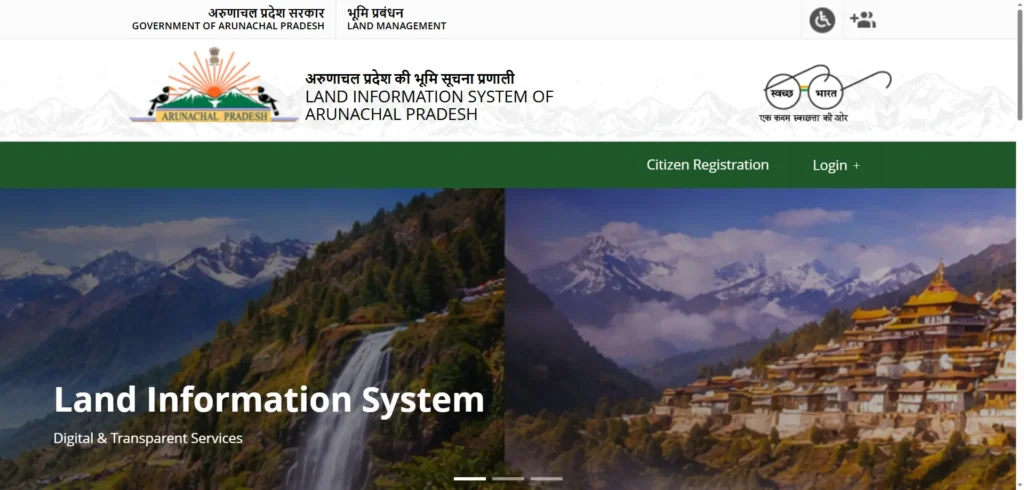
On February 3, 2025, the state’s Land Management Minister, Shri Balo Raja, officially launched two state-of-the-art digital portals designed by the National Informatics Centre (NIC): LISA and NGDRS. These platforms are designed to bring transparency, reduce paperwork, and prevent fraud.
1. The LISA Portal (lisa.arunachal.gov.in)
The Land Information System of Arunachal (LISA) is the state’s central platform for digital land records and revenue collection.
- Paying Annual Lease Rent Online: Historically, landholders had to make multiple visits to the District Land Revenue & Settlement Officer (DLRSO) and wait in lines at the state treasury to purchase physical paper challans. Today, you can log into LISA, view your annual lease rent dues, pay instantly via UPI, net banking, or credit card, and download a digital receipt.
- Instant LHC Verification: To prevent fraudsters from presenting fake land documents, banks, buyers, and legal officers can use the “Verify Certificate” tool on LISA. By entering the certificate reference number and token code, the system will instantly retrieve and display the genuine, registered holding record.
2. The NGDRS Portal (ngdrs.arunachal.gov.in)
The National Generic Document Registration System (NGDRS) is a “One Nation, One Registration” initiative developed by the Department of Land Resources (DoLR).
- Online Property Valuation: Property buyers can log onto the portal, enter the plot’s dimensions and location, and the system will automatically calculate the minimum property valuation based on prevailing government circle rates.
- Digital Deed Submission: You can upload your draft sale deed, gift deed, or mortgage documents directly to the portal for preliminary verification by the Sub-Registrar.
- Prior Appointment Booking: Once your draft deed is approved and fees are paid online, you can book a specific date and time slot to visit the Sub-Registrar Office (SRO) for biometric capturing and final signature execution, completing the process in a single day.
3. The eServices Portal (eservice.arunachal.gov.in)
While LISA and NGDRS handle records and registrations, the Arunachal eServices portal (powered by ServicePlus) manages administrative certificate applications. You can log in to apply for:
- Land Possession Certificates (LPCs).
- Permanent Residence Certificates (PRCs).
- Scheduled Tribe (ST) Certificates.
- Permission for Change of Land Utility (NA Conversion).
Note: You can track the status of your applications on the eServices homepage under “Check Your Application Status” by entering your reference number or OTP.
The Modernisation Reality Check: Navigating the Computerisation Gap
While the state’s digital portals are highly advanced, there is a critical implementation gap between the state’s policy plans and the operational reality on the ground.
Under the federal Digital India Land Records Modernization Programme (DILRMP), which is 100% centrally funded and runs through March 31, 2026, progress in Arunachal Pradesh is slow due to difficult mountainous terrain, poor internet connectivity, and the complexity of customary tribal laws.
The empirical data from the central DILRMP database reveals several critical modernisations gaps:
- Record of Rights (RoR) Computerisation is at 0.00%: Virtually all rural and community land records are still updated by hand in physical paper registers at the local Deputy Commissioner offices.
- Integration of Textual and Spatial Data is at 0.00%: Although the state has digitized many cadastral maps, there is no digital link connecting textual ownership records with physical geographic maps.
- SRO Digital Integration is at 1.72%: Out of the state’s Sub-Registrar Offices, only 2 are fully integrated with the online registry database, while the rest continue to operate manually.
The “Blank Search” Trap
Because of these digitisation gaps, a blank or “no records found” result on the LISA or Land Info mobile app does not mean the land is clean or free from disputes. It usually just means that the unsurveyed parcel has not been digitized yet, and its records are sitting in physical paper ledgers at the district DC office.
Therefore, due diligence in Arunachal Pradesh must always involve a physical search of paper registers at the local revenue and Sub-Registrar offices.
Step-by-Step Guide to Property Registration and Cost Calculations
Under Section 17 of the Registration Act, 1908, any transfer of property worth ₹100 or more must be compulsorily registered to be legally recognized. Property transfers cannot proceed unless the correct stamp duty has been paid.
The Fee Structure
Arunachal Pradesh has a simplified, flat transaction fee structure. Unlike other Indian states that offer progressive concessions for female buyers or joint registrants to encourage property ownership, Arunachal Pradesh enforces a uniform rate.
- Stamp Duty: Flat 6.00% of the property’s market value or circle rate (whichever is higher) for all buyer types.
- Registration Fee: Flat 1.00% of the property value, with no maximum cap.
- Total Legal Charges: 7.00% of the total property valuation.
How to Calculate Your Charges: A Worked Example
Let’s assume you are an eligible APST buyer purchasing a residential plot in Itanagar with a registered agreement value of ₹50,00,000 (50 Lakhs).
Stamp Duty (6.00%) = ₹50,00,000×0.06 = ₹3,00,000
Registration Fee (1.00%) = ₹50,00,000×0.01 = ₹50,000
Total Charges (7.00%) = ₹3,00,000+₹50,000 = ₹3,50,000
Note: Under Section 80C of the Income Tax Act, 1961, stamp duty and registration fees paid on a self-occupied residential property are tax-deductible up to a maximum cap of ₹1.5 Lakhs in a financial year.
The Step-by-Step Registration Process
- Drafting the Deed: Draft your sale deed (Bainama), gift deed, or lease agreement on stamp paper.
- Valuation Check: Access NGDRS to verify the plot’s value against prevailing circle rates.
- Utility Check (NA Conversion): If you are planning to build on agricultural land, you must secure a Non-Agricultural (NA) Conversion Order from the Deputy Commissioner via the eServices portal. This requires submitting your ST Certificate, LPC, plot map, and paying the treasury challan.
- Fee Payment & Booking: Pay your 7% charges online via integrated gateways on the NGDRS portal and book your Sub-Registrar appointment.
- Biometric SRO Visit: Visit the Sub-Registrar Office along with the seller and two witnesses. The officer will capture biometrics (photos and fingerprints), witness the final signatures, and register the deed.
Completing the Loop: Land Mutation (Dakhil Kharij)
Once you walk out of the Sub-Registrar Office with a registered sale deed, your transaction is still not complete. Many buyers make the mistake of assuming that registration is the final step, but registration merely transfers ownership—it does not update the government’s tax registers.
What is Mutation?
Mutation, locally referred to as Dakhil Kharij or Namantaran, is the process where the Revenue Department updates its books to swap the seller’s name for your name as the new taxpayer.
Without completing the mutation:
- The government still treats the seller as the legal owner of the land.
- All official land tax notices and revenue assessments will continue to be sent to the seller.
- You will be unable to leverage the land as collateral for bank loans, as financial institutions require a mutated RoR/Patta in your name.
The Manual Mutation Workflow
Because there is no statewide online mutation system in Arunachal Pradesh, your application must physically move through the local revenue desks:
- Application: Submit your registered sale deed, current land tax receipts, and your APST ST Certificate to the Circle Officer.
- Field Inspection: A revenue surveyor will visit the plot to verify boundary lines and confirm that the measurements match the deed.
- The Gaon Burah Proclamation: The Circle Officer will publish a public proclamation and invite objections to ensure there are no family, boundary, or heritage inheritance claims on the plot.
- Final Entry: Once cleared of objections, your name is entered into the master land register, and you can request a certified copy of the updated RoR/Patta.
Conclusion & Strategic Policy Recommendations
Arunachal Pradesh is taking massive strides towards modernising its land records, bridging a centuries-old gap between customary community holdings and secure, digital property transactions. While the launch of the LISA and NGDRS portals has made urban property administration significantly easier, complete state modernisation requires addressing key structural issues:
- Accelerate Cadastral Surveying: The state should expand its drone-based NAKSHA survey initiative to all rural and agricultural lands, mapping unsurveyed parcels and establishing geographic boundaries.
- Link Textual and Spatial Data: The Revenue Department must prioritize connecting digitized cadastral maps with textual Record of Rights databases to enable automated mutations and issue unique Bhu-Aadhar (ULPIN) IDs.
- Onboard Sub-Registrar Offices: Accelerating the roll-out of NGDRS across all 26 districts will ensure that non-APST buyer checks and protective tribal land laws are enforced uniformly across the entire state.
Due Diligence Checklist for Buyers
Before you make any payments or sign a sale agreement in Arunachal Pradesh, ensure you have ticked every box in this protective checklist:
- ST Certificate Verification: Confirmed the seller is a genuine APST certificate holder.
- APST Buyer Check: Confirmed you are legally eligible to acquire land under Section 88.
- 30-Year Title Chain: Traced the ownership history cleanly back to the original Mula Deed.
- Physical DC Office Verification: Cross-checked paper ledgers at the local DC or Circle office.
- On-Ground Boundary Verification: Physically surveyed the plot limits alongside local Gaon Burah representatives.