
Have you ever tried buying a piece of land or verifying family property in Punjab, only to find yourself lost in a maze of complex revenue terms? Let’s face it: dealing with land records has historically been a headache. Not too long ago, verifying land ownership meant making endless trips to the local Patwari’s (village revenue officer) office, waiting for days, and dealing with manual ledgers that were prone to errors, manipulation, and sometimes, a little “under-the-table” transaction fee.
Thankfully, technology has completely changed the landscape. Through the Punjab Land Records Society (PLRS), the Government of Punjab has digitized decades of land registries, moving them from dusty physical cupboards to a secure, public-facing cloud database. Whether you are a local homebuyer, an NRI keeping an eye on ancestral land, or a lender assessing a loan, the Jamabandi Punjab portal (jamabandi.punjab.gov.in) lets you verify property ownership from the comfort of your living room in just a few clicks.
What is Jamabandi (Record of Rights) in Punjab?
In simple terms, Jamabandi is the official Record of Rights (RoR) of a village. Governed by the historic Punjab Land Revenue Act, 1887, it is the single most authoritative legal document used to establish ownership, possession, and agricultural liabilities for any parcel of land.
Under Section 44 of the Act, a Jamabandi entry carries a strict “presumption of truth” in a court of law. This means the court legally assumes the person listed in the document is the true owner unless proven otherwise with concrete documentary evidence. Every village has its own structured register, historically updated every five years (known as a quinquennial update) to keep the records clean and mathematically aligned.
Jamabandi vs Fard: What is the Difference?
While you will often hear people use these terms interchangeably, they are not exactly the same thing.
- Jamabandi is the master, village-wide land ledger kept by the Revenue Department. Think of it as the giant reference book sitting at the registrar’s office.
- Fard is a certified extract or “photocopy” of a specific parcel’s details taken from that master ledger. If you are selling a plot or applying for a home loan, you don’t hand over the whole village register—you download your specific Fard.
Key Revenue Identifiers Explained: Khewat, Khasra, and Khatauni
To read any Punjab land document without getting confused, you must grasp three foundational terms:
What is a Khewat Number?
The Khewat number is the ownership account identifier. Since agricultural land in Punjab is frequently held by large joint families, a single Khewat number represents a group of co-sharers who jointly own a collective area of land.
What is a Khasra Number?
The Khasra number is the specific plot or survey number. When land consolidation (Murabba-bandi) occurred across North India, the entire state was mapped into distinct, physical parcels, each assigned a permanent survey number.
What is a Khatauni Number?
The Khatauni number is the cultivation account number. It tells you who is actually farming or in physical possession of the plot. For example, you might be the joint landowner (listed under the Khewat), but a tenant or third-party farmer might be listed under the Khatauni.
Step-by-Step Guide: How to Check Jamabandi Punjab Online
Checking your land records online via the official PLRS portal is completely free and takes less than five minutes. Here is exactly how to do it:
1. Navigating the Official PLRS Portal
Open your web browser and head straight to jamabandi.punjab.gov.in. Be careful to avoid unofficial third-party websites that try to charge you for basic searches. On the home screen’s sidebar, click on the “View Jamabandi” tab.
2. Selecting Location & Record Period
You will be prompted to select your location details using four straightforward dropdown menus:
- District: Select the district where the plot is physically located (e.g., Ludhiana, Amritsar, Barnala).
- Tehsil: Select the sub-division/tehsil.
- Village: Select your specific village.
- Year: Always select the most recent year available in the dropdown. Tip: Selecting an outdated year will retrieve an old record, which might miss recent ownership changes.
Once you click “Set Region,” the portal locks in your location.
3. Selecting Your Search Method
Now, choose how you want to search:
- Owner Name Wise: Perfect if you don’t know the exact plot numbers. Type the owner’s name in Punjabi or English. If the owner has a common name (like “Gurpreet Singh”), use their father’s or husband’s name to filter the results.
- Khewat No. Wise: Search by the joint-ownership account.
- Khasra No. Wise: Directly search using the plot’s unique survey number.
- Khatauni No. Wise: Search via the cultivator account.
4. Viewing and Downloading Your e-Fard
After entering your details and the security captcha, click “View Report”. The system will display the official 12-column Jamabandi document. You can immediately print this or download it as a secure PDF for your personal reference.
What is Punjab’s “Easy Jamabandi” Portal?
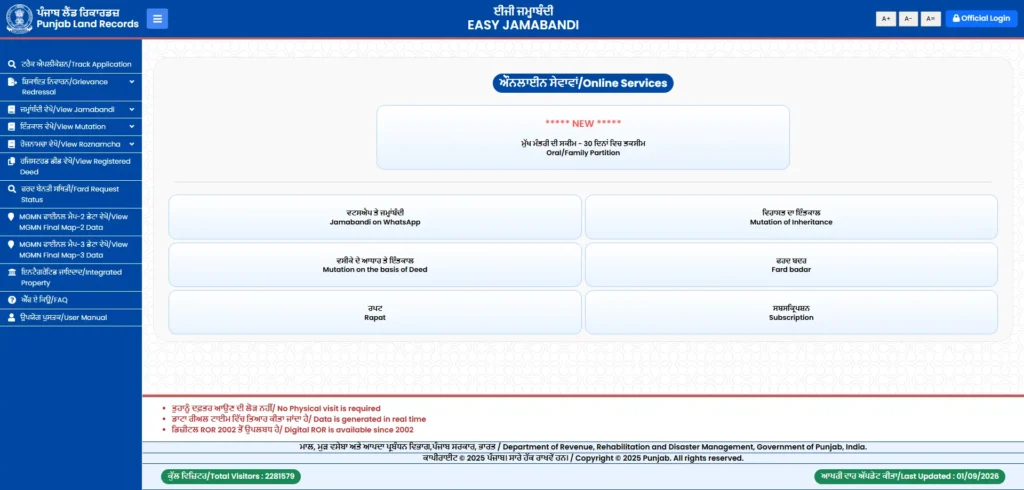
To make land services even more accessible, the Punjab Government launched the revolutionary “Easy Jamabandi” portal (easyjamabandi.punjab.gov.in). This portal digitizes 99% of the state’s villages and introduces a set of transparent, citizen-centric services aimed at dismantling old manual corruption loops.
The 5 Core Digital Services Explained:
1. WhatsApp te Jamabandi (RoR on WhatsApp)
You no longer even need to navigate the main website. By texting Punjab’s official helpline (1076), citizens can request their Jamabandi documents and receive a certified e-Fard directly on their smartphones via WhatsApp, complete with a secure, scannable QR code.
2. Online Intkal (Mutation) in 30 Days
Historically, when you bought property, registering the sale deed didn’t automatically update the master ownership record. This second step, called Mutation (Intkal), could take months or years of chasing officials. Under the new portal, once a sale deed is registered, an online mutation request is triggered automatically and must be resolved within 30 days.
3. Fard Badar Online (Clerical Corrections)
If your name was misspelled or a plot’s area was entered incorrectly, correcting it used to involve a lengthy process at the tehsil office. With Fard Badar Online, you can submit minor typographical corrections and upload supporting documents online, with a mandatory 15-day resolution window.
4. Online Rapat Entries
If a local court issues a stay order or a bank registers a land mortgage, these are logged as immediate digital Rapat entries. Court stay orders must be entered into the system within 24 hours, and bank mortgages must be updated within seven days, instantly freezing any unauthorized sales.
5. NRI Land Alert Subscription
To protect Non-Resident Indians from land-grabbing and illegal unauthorized transfers, landowners can pay a nominal annual fee of ₹500 per Khewat. Once subscribed, the system sends an instant WhatsApp and email alert if anyone attempts to modify, mutates, or even accesses the land records linked to their Khewat.
Important Title Verification Tips for Land Buyers in Punjab
Buying land is one of the biggest financial decisions you will ever make. To protect your hard-earned money and ensure your home loan gets approved smoothly, keep this title verification checklist handy:
1. Watch Out for “Red Ink” Remarks in Column 12
Because the main Jamabandi body is only updated every five years, any property sales, gifts, mortgages, or court stay orders that occur in between are logged in the Remarks Column (Column 12) in distinct red ink.
Always look at Column 12 before handing over any advance money. If the seller’s name is not in the primary ownership column, make sure there is a valid, approved mutation entry written in red ink proving they purchased it from the previous owner.
2. Verify CLU (Change of Land Use) Certificates
If you are buying agricultural land on the outskirts of Ludhiana or Mohali to build a home, verify that the developer has a valid CLU (Change of Land Use) certificate. Lenders like Tata Capital or Bajaj Finance will outright reject home loan applications if you try to build a residential property on agricultural land without a verified CLU.
3. Check for Post-Consolidation Plot Re-numbering
If you run a Khasra search and get a “no record found” error, don’t panic. When rural areas undergo physical consolidation, plot shapes are redrawn and assigned entirely new survey numbers. In such cases, run an “Owner Name Wise” search to find out the newly assigned Khasra identifiers.
Administrative Recourse: Filing an RTI for Punjab Land Records
What if you discover a discrepancy on the portal, or local revenue officials are delaying your mutation? You have legal tools at your disposal.
Under the Right to Information (RTI) Act, every citizen has the statutory right to request physical certified copies of historical land records, field maps (Aks Shajra), and daily diary logs (Roznamcha) directly from the Revenue Department.
Step-by-Step Guide to Filing an RTI in Punjab:
- Identify the Public Information Officer (PIO): Address your application to the PIO of the local Tehsil/Revenue Office where the land is situated.
- Draft the Application: Keep your request highly specific. Avoid general questions. Ask for exact copies of the documents you need (e.g., “Provide a certified copy of daily diary entry (Rapat) No. X dated Y, or the certified mutation sheet for Khewat No. Z”).
- Pay the Nominal Fee: Attach a fee of ₹10 (via an Indian Postal Order/e-RTI gateway).
- Processing Timeline: By law, the PIO must deliver the requested documents or issue a formal response within 30 days of receiving your application. If they fail to do so or try to charge unreasonable fees, you can file a first appeal, and subsequently a second appeal to the Punjab State Information Commission.
Frequently Asked Questions (FAQs)
Is an online e-Fard copy legally valid for bank loans and court cases?
Yes. Under the digitized PLRS guidelines, e-Fards downloaded from jamabandi.punjab.gov.in that feature a digital signature and verifiable QR code are legally recognized as equivalent to physically attested copies. They are fully accepted by banks for mortgage registration, registry offices, and courts.
What should I do if my name is misspelled in the online Jamabandi?
You can use the Fard Badar module on the Easy Jamabandi portal to submit an online correction request. Upload your registered sale deed, Aadhaar card, or school certificate showing the correct spelling. The revenue officer is legally required to resolve the discrepancy within 15 days.
Does the Jamabandi portal cover urban properties inside cities?
Generally, no. Jamabandi Punjab primarily tracks agricultural, semi-urban, and rural land records. Properties located deep within municipal corporation limits are managed under different municipal registry systems or property tax registers. However, semi-urban plots on the city outskirts are usually covered.
How often are online land records updated in Punjab?
While the master Jamabandi register undergoes a comprehensive, village-wide update every five years, the online portal updates transactional details immediately upon the formal approval of any mutation, Rapat entry, or mortgage.
Disclaimer: Online land records are excellent for personal verification, but for final legal sales or complex disputes, always secure an officially certified copy from your local Tehsil office.