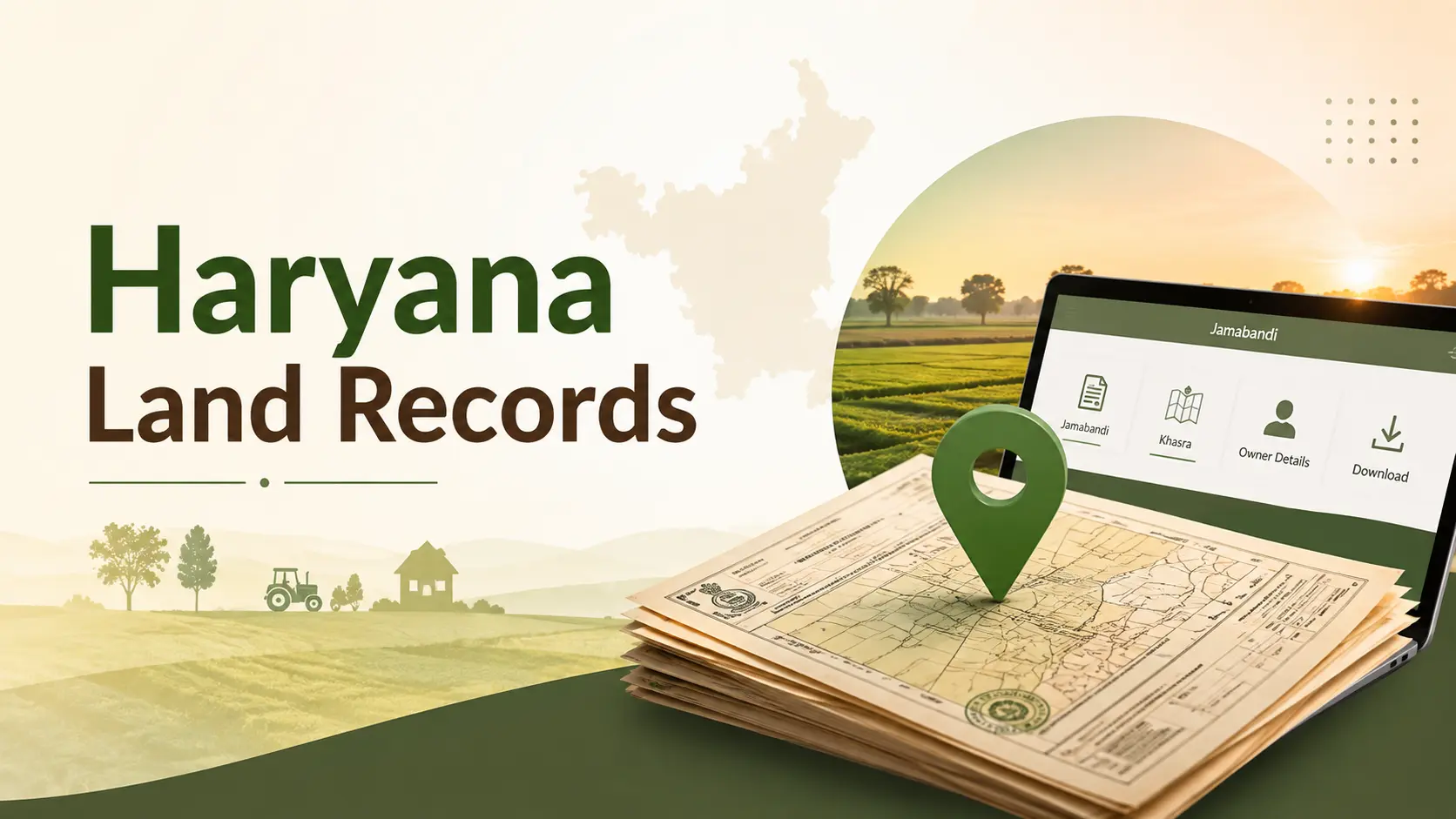
The administration, maintenance, and spatial updating of land records in the state of Haryana are undergoing a massive technological revolution. Historically governed by manual registers and complex legacy systems, the state’s modern digital infrastructure—spearheaded by Web-HALRIS—now enables unprecedented transparency and ease of access for citizens. Whether you are a property buyer looking to conduct a rigorous title search in Gurugram, a long-term landowner verifying family shares, or a financial institution underwriting a home loan, understanding the legal and operational architecture of Jamabandi Haryana is absolutely essential.
This comprehensive, source-grounded guide provides an exhaustive walkthrough of Haryana’s land record system, updated with the latest legislative amendments, administrative guidelines, and digital certified copy modules launched in 2025 and 2026.
What is Jamabandi in Haryana? Legislative Foundations and Vernacular Framework
Have you ever wondered how land records actually work when you buy or own property in Haryana? The system can seem like a dense maze of historical terminology, but once we break down the terms, it is remarkably logical.
In the language of Haryana’s land administration, the master document that establishes land ownership, tenancy, and cultivation patterns is known as the Record of Rights (RoR), or more commonly, the Jamabandi. If you have done due diligence in other states, the concept is exactly the same—only the local vocabulary changes.
The Punjab Land Revenue Act, 1887 and the Presumption of Truth
The legal weight of a Jamabandi Haryana document is grounded in a historical law that still governs property today: the Punjab Land Revenue Act, 1887. Two sections of this Act are crucial for every property owner to know:
- Section 31: Mandates that a detailed Record of Rights must be compiled and maintained for every single estate or revenue village in the state.
- Section 44: Attaches a strict legal presumption of truth to all entries recorded in a sanctioned Jamabandi.
What does this “presumption of truth” mean in simple terms? It means that in any court of law, a sanctioned Jamabandi is accepted as correct. If someone wants to challenge the ownership recorded in it, the entire burden of proof lies on them to prove the record is wrong. This makes the Jamabandi the ultimate document for checking property titles, applying for bank loans, and resolving boundary disputes.
Vernacular Terminologies: Reconciling the Five Pillars of Land Records
To feel confident navigating the online portal (jamabandi.nic.in), let’s demystify the five most common terms you will encounter:
- Jamabandi (Record of Rights / ROR): Think of this as the master ledger of a village. Traditionally, it was compiled manually every five years by the Patwari (village-level revenue official) and verified by a higher Revenue Officer (like a Tehsildar). Two copies are created: one is kept in the District Record Room, and the other remains with the Patwari.
- Fard (Fard Nakal): This is simply a local word for a copy or extract of the Jamabandi. When you apply for a copy of your land records for a home loan, the document you receive is called a Fard Nakal.
- Khewat (Owner Account): A Khewat number represents a master account of co-owners who jointly own a collection of plots in a village. Note that Khewat numbers are updated and renumbered during every five-year revision cycle, so always check the most recent year.
- Khatauni (Cultivator Account): Sitting subordinate to the Khewat is the Khatauni number, which tells you who is physically possessing or cultivating the land. While the owners are listed under the Khewat, the actual cultivator or tenant is recorded under the Khatauni.
- Khasra (Plot Number): This is the unique plot or survey number assigned to a specific parcel of land on the village map. If a plot is divided among heirs or sold in portions, you will see it written as a fraction (e.g., Khasra
100/1or100/2). Unlike Khewat numbers, Khasra numbers remain permanent across revision cycles. - Intkaal (Mutation): Since the Jamabandi is updated comprehensively only once every few years, any transaction that happens in between—like a sale, inheritance, or gift—is recorded as a mutation (Intkaal). Reconciling the current mutation status is critical, as a title chain is incomplete until the mutation is approved and updated in the Jamabandi.
Structural Analysis: Decoding the 12 Columns of the Jamabandi Ledger
A certified copy of Jamabandi Nakal Haryana is arranged in a standardized 12-column table. To check a title properly, you must read the columns horizontally as a continuous row—never looking at individual numbers in isolation.
Let’s walk through what every single column means, what to look for, and the warning signs (risk flags) that should make you halt a transaction:
| Column Number | Statutory Designation | What It Records | Crucial Diligence Check & Risk Flags |
|---|---|---|---|
| Column 1 | Khewat Number | The ownership account number assigned to a specific owner or a group of joint co-owners. Written in black ink. | Watch-out: Can change completely during the 4-to-5-year revision cycle. A suffix of “MIN” (e.g., Khewat 45 Min) indicates a subdivision of an original parent holding. |
| Column 2 | Khatauni Number | Identifies the specific holding of the person responsible for the actual cultivation or physical possession of the land. | Establishes the link between the landowner and the occupier. If the owner is cultivating the land directly, the entry will show Khudkasht. |
| Column 3 | Patti, Taraf, or Numberdar | Records the location-based subdivision of the revenue estate (village), organized in accordance with the genealogical tree (Shajra Nasab). | Helps localize historical property coordinates. In traditional rural villages, names of Pattis may reflect community, clan, or historical caste groupings. |
| Column 4 | Landowner Details | Records the full names, parentage (father’s and grandfather’s names to prevent identity duplication), ownership shares, and address of the registered landowners. | Diligence Check: Crucial for validating joint ownership proportions. If a partnership firm or corporation is listed, the registered details must precisely match corporate files to establish joint liability. |
| Column 5 | Possession/Cultivator Details | Shows the legal status of the physical occupier. Typical entries include Khudkasht (owner self-cultivating), Gair Dakhildaar (unauthorized permanent possession), or various categories of tenants-at-will. | Critical Risk: If a tenant-at-will or an unauthorized occupant is registered here, a buyer faces severe eviction and possession-transfer challenges. |
| Column 6 | Naam Chah etc. | Records aliases, local identifiers, or alternative names of the cultivator for supplementary identity verification. | Rarely populated or relevant in highly urbanized areas like Gurugram, but useful in verifying legacy rural identities. |
| Column 7 | Khasra Number | Unique cadastral parcel or plot number given to the field in the official village map (Shajra Kishtwar). | Subdivisions due to sales or transfers are written as fractions (e.g., 25//12/1 and 25//12/2). This remains constant across Jamabandi cycles. |
| Column 8 | Area & Land Classification | Specifies the exact physical size of the Khasra plot in local units (Kanals, Marlas, or Sarsahis) and details the classification of the land. | Key Terms: Distinguishes agricultural land types based on irrigation (e.g., Chai for well-irrigated, Nehri for canal-irrigated, or Barani for rain-fed) and marks uncultivable land as “Gair Mumkin”. |
| Column 9 | Rent & Revenue Details | Outlines the rent paid by the cultivator (whether as a share of the produce like Batai, or as a fixed lump sum). | Indicates the financial arrangement between the landlord and tenant. |
| Column 10 | Bachh / Government Ledger | Records the share of village tax or the distribution of community revenue liabilities. In urban contexts, it records land owned by municipal or state departments. | Prevents the unauthorized registration or sale of public lands, community forests, or department-owned assets. |
| Column 11 | Land Revenue Payable | Records the land revenue assessed, showing any exemptions (Muafi) or assigned revenue (Jagir) in red ink. | Primarily of historical and fiscal interest; largely obsolete for standard urban residential or commercial transactions. |
| Column 12 | Remarks & Mutations | The ultimate real-time risk register. Tracks pending mutations, court injunctions, land acquisitions, banking mortgages, or government Takavi loans. Written in red ink to signify changes. | Strict Diligence Rule: Never buy land if Column 12 contains a pending mutation reference, a bank lien, or an active stay order from a civil or revenue court. |
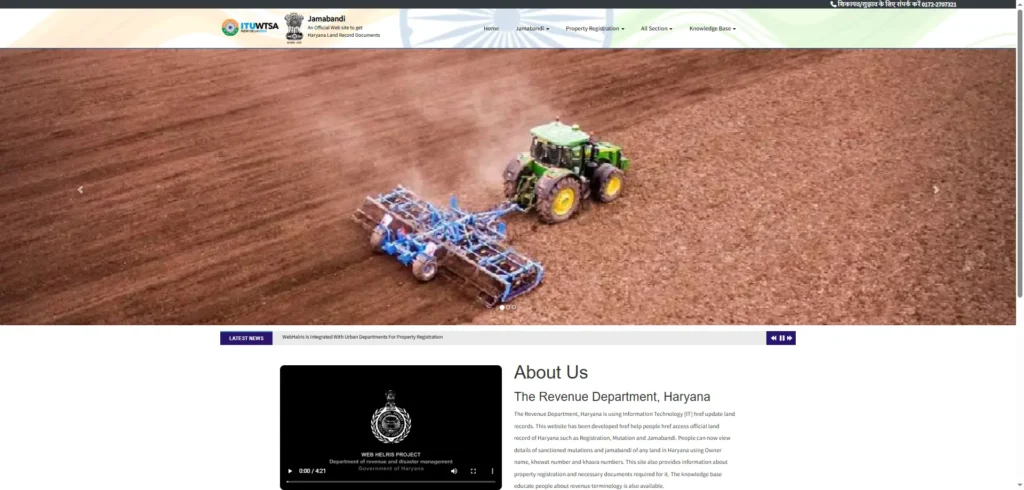
How to Check Jamabandi Haryana Online: A Step-by-Step Web-HALRIS Walkthrough
Checking your land records online in Haryana is now incredibly simple and free! The state government has digitized over 1.3 crore land records on its centralized platform, Web-HALRIS.
Whether the property is in Gurugram, Faridabad, or a rural village, all records are accessed via the official portal: jamabandi.nic.in
Steps to Pull a Reference Copy:
Follow this step-by-step SOP to access the Jamabandi Nakal Haryana for checking:
- Open the Portal: Go to the official website: jamabandi.nic.in.
- Navigate to Nakal section: On the homepage, hover over the “Jamabandi” menu option and click on “Jamabandi Nakal for Checking”.
- Select Location Details: Fill in the location fields from the drop-down menus (do not type manually):
- District (e.g., Gurgaon or Faridabad)
- Tehsil/Sub-Tehsil (e.g., Gurgaon, Manesar, or Sohna)
- Village (Take extra care here, as several villages in Haryana have identical names)
- Jamabandi Year (Always select the latest available year to get current data)
- Choose Your Search Method: You can search using four convenient parameters:
- By Owner Name: Enter the owner’s name in Hindi. This is great for a quick check, but watch out for spelling differences and duplicate regional names.
- By Khewat Number: Choose this if you want to see the master ownership account details.
- By Khasra/Survey Number: This is the most precise and highly recommended search path. Just enter the plot number from your sale deed.
- By Date of Mutation: Perfect for tracking a recent transfer.
- View and Print: The system will display the matching record on your screen. You can take a screenshot or print it to a PDF.
Online Reference vs. Offline Certified Copies: Balancing Diligence Paths
When buying a home or applying for a mortgage, it is critical to know that the copy you view online for free is only a reference copy. It does not carry legal validity. Let’s look at the key differences between the two paths to make sure you use the right document for the right purpose:
Key Differences:
- Online Nakal for Checking: This is a free, unsigned, digital document. It is perfect for initial checking, monitoring your property, and verifying land details from home. However, it is not accepted by banks for home loans or by courts for resolving disputes.
- Tehsil-Certified Copy: This is a printed extract of the land record issued directly at the Tehsil office. It is physically signed and stamped by the Tehsildar or Patwari. This is a legally binding document required for executing sale agreements, taking out bank loans, or filing court cases.
How to Get a Certified Copy Offline:
If you need a formal certified copy (often locally called the certified Fard), follow this standard procedure:
- Go to the HALRIS center physically located at the Tehsil or Sub-Tehsil office where your land is registered.
- Provide the computer operator with your village name, Khewat, or Khasra number.
- Pay the small statutory fee (typically around ₹30).
- Collect your stamped, printed, and signed certified Nakal from the officer.
Error Correction: Administrative Fard Badar vs. Civil Court Adjudication
What should you do if you pull up your land records online and discover a spelling mistake in your name, a wrong father’s name, or a calculation error in your joint ownership shares?
Depending on the nature of the mistake, you must follow either an administrative correction path or a civil court path.
The Fard Badar Procedure (Para 7.29 of HLRM)
If the error is a straightforward typing or copying mistake—where the legacy physical registers are correct, but the digitized database has a typo—it can be fixed quickly without going to court. This process is called a Fard Badar.
This administrative route is governed under Para 7.29 of the Haryana Land Records Manual (HLRM). To ensure citizens are not unnecessarily dragged into civil courts for basic typographical typos, the Financial Commissioner Revenue (FCR), Haryana, issued a strict directive (Memo dated 17.06.2022).
The FCR made it clear that if a digital error is simply a mismatch between the online records and the older physical files (such as the Misal Haquiat—the first Jamabandi prepared after consolidation), it must be corrected administratively via a Fard Badar.
Steps for a Fard Badar Correction:
- Retrieve Legacy Copy: Get a certified copy of the historical physical Jamabandi to prove the correct spelling or share value.
- Submit Application: Draft an application citing HLRM Para 7.29 and submit it to the local Tehsildar or Patwari.
- Field Inquiry: The Patwari and Field Kanungo verify your claim by checking the original legacy physical archives. If they find a typo, the Patwari enters a temporary “Fard Badar” notation in Web-HALRIS.
- Official Approval: The Assistant Collector Grade-II (AC-II) reviews the verification report and officially signs off on the correction. The online database is then permanently updated.
When Is a Civil Court Stay Required?
If the error is not a simple typographical mistake and instead involves a dispute over actual ownership rights, contested inheritance claims, or allegations of fraud, a Fard Badar cannot be used. The Fard Badar is strictly barred for contested titles. In these scenarios, the parties must file a civil suit and secure a formal decree or stay from a competent Civil Court.
Modern Policy Transformations & Digital Reforms (2025/2026)
Between 2025 and 2026, the Government of Haryana enacted some of the most advanced land record reforms in Indian history, making property ownership more secure and transparent than ever before.
I. Automated Joint Holding Partition: The Haryana Land Revenue (Amendment) Act, 2025
Joint land holdings have historically been a major source of litigation in Haryana. Often, several co-sharers own a large plot together; they may farm separate portions, but the boundaries are not marked on paper, leading to disputes and fraudulent sales.
To solve this, the legislature passed The Haryana Land Revenue (Amendment) Act, 2025 (published on March 12, 2025, Bill HLA-HLA of 2025):
- Suo-Motu Notice (Section 111A): Now, whenever a transaction creates a joint land holding (except between a husband and wife), the Revenue Officer must automatically issue a suo-motu notice to all co-owners. The owners are given six months to divide and partition the land by mutual agreement.
- Individual Partition (Abolition of Section 114): Under the old law, a partition application required dividing the entire joint holding, which disrupted all co-owners. The 2025 Amendment deletes Section 114 entirely. Now, any single co-owner can apply to partition only their specific portion, leaving the other co-sharers completely unaffected. The system then draws a precise Tatima sketch (partition map) to update the map.
II. Regularization of Rural Property: The Haryana Abadi Deh Ordinance, 2025
Historically, the inhabited residential areas of villages lay inside a boundary line known as the Lal Dora. These areas were excluded from revenue mapping, meaning residents did not have legal title deeds. They could not get home loans, register sales cleanly, or defend against encroachments.
The Haryana Abadi Deh Ordinance, 2025 (promulgated on November 26, 2025) officially ended this historical vacuum:
- Elimination of the Lal Dora Line: This ordinance sets up a legal framework to identify, record, and verify ownership inside rural abadi areas.
- High-Resolution Drone Surveys: Using high-resolution drones under the SVAMITVA Scheme, the state maps every household to generate precise, georeferenced maps.
- Property Cards: Residents are issued legally binding individual property cards/title deeds, which are fully integrated into Web-HALRIS. This allows them to secure bank home loans easily.
III. The Online Certified Copies Module (2026 Portal Launch)
In an incredible, citizen-centric move launched on July 27, 2026, the Haryana Government launched a completely online system to apply for and download digitally certified copies of your Jamabandi, Mutation, Fard Badar, and registered sale deeds from home!
Step-by-Step SOP to Apply Online:
- Login: Go to the secure portal and log in using your mobile number and OTP verification.
- Create Request: Click on “Start a New Request”.
- Select Details: Select your District, Tehsil, and Village. Choose the document type you need (Jamabandi, Mutation, or Fard Badar). For sale deeds, enter the registered deed number and date of execution.
- Scrutiny: The request is routed to the concerned Patwari, who reviews the details against the master database.
- Fee Payment: Upon approval, pay the standard online fee:
- ₹100 for a certified Mutation, Fard Badar, or Registry.
- ₹100 for the first 10 pages of a certified Jamabandi, plus ₹5 per additional page.
- QR-Verified Download: Once paid, download your digitally certified copy. It comes with a secure QR code and has the exact same legal validity in courts and banks as a physical copy stamped at the Tehsil.
IV. NRI Land Record Monitoring and Alert Subscription
To protect non-resident Indians (NRIs) and remote landowners from fraudulent land grabs, Haryana launched a secure NRI subscription service in 2026. NRIs can subscribe to receive real-time SMS and email alerts whenever any query, mutation request, or transaction is initiated against their registered Khasra plots.
Conclusion: Golden Rules of Land Record Diligence for Haryana Property Buyers
When buying or investing in property in high-growth regions of Haryana, never rely solely on verbal promises, broker screenshots, or historical papers. Protect your hard-earned money by executing these three golden rules of due diligence:
- Verify the Mutation (Intkaal) Status: Always verify that any registered deed executed by the seller has a corresponding completed mutation (Intkaal) entry recorded in Column 12 of the Jamabandi. If a mutation is still pending or has been rejected, the seller does not legally hold marketable title to transfer the property.
- Verify the Crop Inspection Register (Khasra Girdawari): Before buying any agricultural or peri-urban land, verify the Khasra Girdawari. This register records actual physical possession, crop yields, and irrigation sources twice a year. It protects you against hidden, legally protected tenant claims that may reside in Column 5.
- Reconcile the Registration and Revenue Chains: Never view a sale deed in isolation. Reconcile the sale deed chain from the HARIS registration software with the active text records in Web-HALRIS and the georeferenced boundary lines in the Bhu-Naksha map. Only when all three systems reflect a clean, unified title should you proceed with the property transaction.