
Introduction: The Unique Architecture of Land in Mizoram
If you have tried searching for land records in Mizoram, you might have noticed how different it is from other Indian states. Traditionally and culturally, Mizoram has been classified as a “non-land record state” by the state’s own Land Revenue & Settlement (LR&S) Department. This means that, unlike states like Uttar Pradesh or Punjab, Mizoram has historically operated without a centralized, unified, or state-wide computerized Jamabandi-style Record of Rights (RoR).
Instead, land governance in Mizoram has relied on parallel manual registers kept at the district level by the local Deputy Commissioner (DC) offices, local Settlement Officers, and local customary authorities. The hilly and rugged terrain of this beautiful state has historically made uniform, accurate ground-based cadastral surveys a massive administrative headache.
However, things are changing fast. Under the Digital India Land Records Modernization Programme (DILRMP) and the state’s own flagship e-Ram portal (eram.mizoram.gov.in), the Government of Mizoram is currently executing a phased digital transition. This transition consolidates textual records, digital mapping, and transaction history into a single, secure database. But before we dive into the online registration steps, let’s understand how the entire legal land revenue system in Mizoram actually functions.
Understanding Mizoram’s Land Revenue System: LSC vs. Patta
To safely navigate any property transaction, land purchase, or dispute in Mizoram, you must first understand the transition from traditional, customary Mizo land-owning patterns to modern statutory laws.
The Evolution from Traditional Chieftainship to Statutory Law
For generations, land in the Mizoram hills was collectively managed by traditional village chiefs. The land belonged to the community, and the village chief distributed agricultural tracts (Jhum farmlands) among households based on local custom.
This traditional chieftainship was formally abolished after India’s independence with the enactment of the Assam-Lushai District (Acquisition of Chief’s Rights) Act, 1954, which transferred collective land administration authority directly to the state and newly formed local Village Councils.
To bring order, boundaries, and systematically assessed land revenue into the region, the Mizo Council enacted The Mizo District (Land and Revenue) Act, 1956. This legislation laid down the first formal statutory structure for recording landholdings in a General Register. The 1956 Act fundamentally divided land possession into two main tenures:
- Pass-Holders: Individuals holding temporary land passes, which conferred only temporary rights of use and occupancy for a specified period. These temporary passes carried absolutely no heritable or transferable rights, and strictly prohibited sub-letting.
- Settlement-Holders: Individuals holding permanent settlement leases, which granted fully heritable and transferable rights of use, title, interest, and sub-letting. This was subject to the regular payment of legally assessed land revenue, taxes, and cesses.
In 2013, the state assembly unified and modernized these practices by passing the Mizoram (Land Revenue) Act, 2013 (Act No. 5 of 2013). This Act regulates the allocation, use, occupation, transfer, and taxation of all lands and buildings across the state, except for the Sixth Schedule Autonomous Districts.
Classifications of Landholders under the Mizoram Land Revenue Act, 2013
Under Section 21 of the 2013 Act, landholders in Mizoram are legally categorized into four distinct classes:
- Land Settlement Certificate (LSC) Holder: Issued to individuals or juristic entities for permanent land settlement, whether for agricultural or non-agricultural purposes (such as residential or commercial construction). LSC holders possess permanent, heritable, and transferable rights over their properties.
- Crucial Constitutional Restriction: Under Article 371G of the Constitution of India and Section 98 of the Mizoram (Land Revenue) Act, 2013, land transfers are restricted strictly to tribal residents domiciled in the state of Mizoram. Any transfer of land to a non-tribal person or entity requires prior, explicit sanction from the State Government.
- Periodic Patta Holder: Issued for agricultural land use, commercial plantations, or horticulture for a fixed or limited period. Legally, a Periodic Patta holder is classified as a “temporary licensed cultivator”. Periodic Pattas carry strict transfer and inheritance limitations. They cannot be mortgaged, sold, or sublet without prior, written permission from the State Government. If the patta does not specify a duration, its validity is capped at five years from the commencement of the 2013 Act, unless formally renewed.
- Pass Holder: Temporary permission granted by the government or, in unsurveyed village perimeters, by the local Village Council strictly for constructing residential houses, shops, or stalls. Pass holders have no rights over the soil beyond temporary use and occupancy. Subletting, inheritance, or transfer of a Pass is strictly prohibited. If no period is specified, its validity expires five years from the commencement of the 2013 Act.
- Lease Holder: Issued to individuals, organisations, or public entities let out by the State Government for specific tenures (up to 99 years) and approved commercial, industrial, or developmental purposes. A leaseholder must develop the land in strict compliance with the lease conditions, and failure to seek timely renewal upon expiry results in automatic termination of the lease.
e-Ram Mizoram Login: How to Search Land Records Online
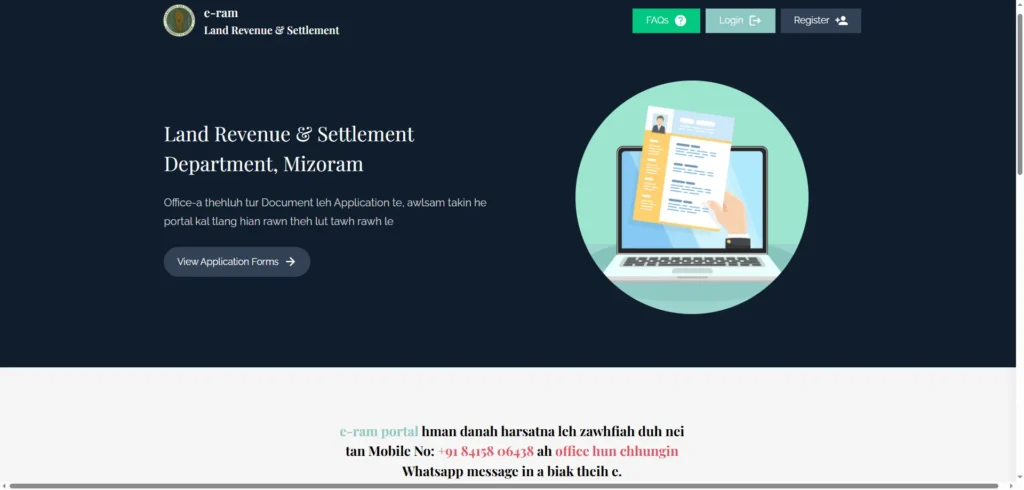
The launch of the centralized e-Ram land records portal (eram.mizoram.gov.in) in November 2024 represents a massive leap forward for the state’s digital land governance. Developed by NIC Mizoram and funded by the Ministry of Development of North Eastern Region (DoNER), the portal digitises 27 land-related services, including property registration, periodic patta, land leases, house sites, and name transfers.
Step-by-Step Portal Registration on e-Ram
If you are a property owner, legal heir, or prospective buyer looking to access official land data or file an application, you must first register on the e-Ram portal. Here is how:
- Access the Portal: Open a secure web browser and navigate to eram.mizoram.gov.in.
- Citizen Registration: Click on the “e-Ram” tab to access the citizen login interface, then select “Register”.
- Submit Personal Details: Fill out the registration form by entering the following details exactly as they appear on your official government identity documents:
- Full Name of the Applicant.
- Date of Birth (DOB).
- Father’s and Mother’s Names.
- Aadhaar Card Number.
- Voter ID Card Number.
- Mobile Phone Number.
- Complete Physical Address.
- Upload Documents: Upload scanned, high-resolution copies of your Aadhaar Card, Voter ID, or other government-approved residency and identity proofs.
- OTP Verification: Click “Submit Registration”. You will receive a secure One-Time Password (OTP) on your registered mobile number. Enter the OTP to finalize your credentials.
- Subsequent Logins: Future portal access requires entering the registered mobile number and completing OTP verification.
Tracking Your Land Survey Application
If you have applied for fresh boundary surveys, LSC issuances, or land partitions, you can track the real-time processing of your application:
- Navigate to the e-Ram homepage and click the “Track Survey Application” option.
- In the search field, input your unique, system-generated Survey Application Number.
- The system will instantly display the file’s current status, processing stage, and the name of the assigned government surveyor.
How to View and Download Cadastral Maps
To check the exact boundary lines of a plot and verify that there are no overlapping claims:
- On the e-Ram main navigation bar, click on “Revenue Map” or “Village Map”.
- Use the dropdown menus to select the specific District, Sub-Division/Hobli, and Village.
- If surveyed cadastral data is available, the interactive map will render on your screen.
- The portal allows registered users to download the geo-referenced village map in PDF format for physical printing or legal reference.
Land Tax Pek Dan: How to Pay Land Revenue and Zoramchhiah Online
Under Section 47 of the 2013 Act, all allotted land in Mizoram is subject to the payment of annual land revenue, taxes, or cesses. The state has consolidated these payments through the online treasury portal landtax.mizoram.gov.in.
Paying Your Standard Land Tax
To clear outstanding annual taxes on settled agricultural, residential, or commercial holdings:
- Go to the official tax portal: landtax.mizoram.gov.in.
- Select the “Land Tax” option.
- Enter your family’s unique Family ID. The portal will query the database and retrieve all properties linked to that Family ID, along with calculated tax dues, current rates, and historical arrears.
Paying Zoramchhiah (Local Land Revenue)
Zoramchhiah represents local land revenue levies assessed on village-level holdings.
- On the landtax.mizoram.gov.in homepage, select “Zoramchhiah”.
- Input your 12-digit Ration Card Number. The system will display local land tax obligations registered under your household.
BBPS Integration and Payment Verification
To simplify payments, the land tax portal is integrated with the Bharat Bill Payment System (BBPS). Landowners can complete transactions using credit cards, net banking, or unified payment apps such as Google Pay, PhonePe, Paytm, and BHIM.
Once a transaction is processed, the portal generates a digital receipt. These receipts feature a QR-code that can be scanned on the portal to instantly verify the transaction’s authenticity. This step is crucial for clearing property tax records before initiating a property sale.
Hmingthlak Dilna: How to Apply for Land Mutation
Hmingthlak Dilna (land mutation) is the formal administrative process of substituting the name of the previous landowner with that of the new owner in the official General Register and Record of Rights (RoR). Mutation is required following a property sale, gift, partition, or inheritance.
The Aizawl District Mandate vs. Other Districts
On March 17, 2025, the Land Revenue & Settlement Department issued a public directive making online filing strictly mandatory for all land applications—including Hmingthlak Dilna, periodic patta applications, and house pass submissions—within Aizawl District.
For Aizawl residents, manual, physical filings are no longer accepted. Citizens who do not have personal internet access must submit their mutation files through the nearest Common Service Centre (CSC) on payment of standard, government-approved user fees. In contrast, other districts in Mizoram are still transitioning to the digital workflow and continue to accept physical files at local Assistant Settlement Officer (ASO) counters.
Step-by-Step Hmingthlak Dilna (Mutation) Checklist
The procedural requirements, costs, and timelines for mutation vary depending on whether the property is located within Aizawl District:
| Feature / Parameter | Hmingthlak Dilna – Online (Aizawl District Pilot) | Hmingthlak Dilna – Offline (Other Districts) |
|---|---|---|
| Submission Mode | Digital upload via eram.mizoram.gov.in. | Physical submission to the local Assistant Settlement Officer (ASO). |
| Application & Processing Fees | ₹20 form fee; ₹10 transaction fee; plus ASO processing charges ranging from ₹300 to ₹560. | ₹20 form fee; ₹10 transaction fee; plus ASO processing charges ranging from ₹300 to ₹560. |
| Valuation Fee | 0.5% valuation fee assessed on property sales or gifts (inheritance cases are exempt). | 0.5% valuation fee assessed on property sales or gifts (inheritance cases are exempt). |
| Witness & VCP Signatures | Digital upload of signed witness forms and the mandatory Village Council President (VCP) endorsement. | Submission of paper forms containing physical witness signatures and the VCP endorsement stamp. |
| Required Supporting Documents | Scanned copies of the original LSC/Patta, registered Sale/Gift Deed, tax clearance receipt, party IDs, and Heirship Certificate (for inheritance). | Physical copies of the original LSC/Patta, registered Sale/Gift Deed, tax clearance receipt, party IDs, and Heirship Certificate (for inheritance). |
| In-Person Verification | Both parties must appear in person before the ASO for biometric and final signature verification upon SMS notification. | Both parties must physically appear before the ASO to sign the transaction documents. |
| Typical Processing Timeline | Approximately 2 business days if no fresh field measurements or physical surveys are required. | From several days to weeks, depending on surveyor availability for physical field measurements. |
Sixth Schedule Autonomous Districts: LADC, CADC, and Mara Land Records
A common mistake made by generic real estate websites is applying state-level land laws to the entire state of Mizoram. Under Section 1 of the 2013 Act and Section 1 of the 1956 Act, state-level land revenue laws explicitly exclude the Autonomous Districts of Lai, Mara, and Chakma.
These areas are governed under the Sixth Schedule of the Constitution of India, which vests independent legislative and executive authority over land allotment, surveying, and revenue collection directly in the respective Autonomous District Councils (ADCs).
Land Administration under the Lai Autonomous District Council (LADC)
The LADC Land Revenue & Settlement Department operates under its own executive committee, overseen by an Executive Member in-charge and a Senior Revenue & Settlement Officer.
- LADC Allotment Workflow: Allotting land requires a formal application, a physical boundary survey, and a technical sketch map.
- ADC Size Limits: Agricultural allotments are capped at a maximum of 5 hectares, and residential house sites are strictly limited to 600 square meters. Allotments exceeding these limits require prior, written approval from the LADC Executive Committee.
- Commercial Grading and Taxation: The Executive Committee classifies residential and agricultural lands into Grades A, B, and C based on commercial viability and road proximity. Annual land taxes are assessed according to these grades.
- Non-Tribal Transfer Bar: Land settlements within LADC are restricted; no land may be settled with or transferred to non-tribal persons.
Land Dispute Resolution in the Chakma Autonomous District Council (CADC)
The CADC administers land under its own local legislation, specifically the CADC (Agricultural Land) Act, 1982, the CADC (Land & Revenue) Act, 2002, and the CADC (Revenue Assessment) Regulation Act, 2002.
- Dispute Arbitration: To handle boundary overlaps and title disputes, the council established the CADC Land Dispute & Settlement Advisory Board. Headed by the Chief Executive Member, the Board conducts investigations, accesses registers, and submits final recommendations to the Executive Committee for arbitration.
- Town Planning Restrictions: Within towns like Kamalanagar, the CADC enforces strict roadside planning rules. Property owners must secure construction permits and No Objection Certificates (NOCs) from the Town Planning Committee to prevent road encroachment and traffic congestion.
Stamp Duty and Registration Fees in Mizoram (2026)
Property registration costs in Mizoram are determined by state-specific regulations. Calculations are based on the higher of the declared agreement value or the government guidance value (market value).
The 2024 Stamp Duty Amendment Rate
Under the Indian Stamp (Mizoram Amendment) Act, 2024 (Act No. 4 of 2024, gazetted on March 15, 2024), the State Assembly significantly reformed its property tax structure. The standard stamp duty on property sales deeds was increased from 1% to 3% of the property’s market value. This hike was implemented to curb artificial land price inflation and generate revenue for public infrastructure, such as the Aizawl Smart City initiative.
Special 2.5% Concession for Widows
The 2024 Amendment introduced a progressive social concession, offering a discounted 2.5% stamp duty rate for sole widow purchasers registering property in their names. To qualify for this concession, the buyer must meet a strict statutory definition:
- A woman who has lost her spouse through death, divorce, or other legal separation.
- Must live in an independent household (separate house, separate kitchen).
- Must be the sole purchaser of the property.
- Note: There is no general stamp duty discount for non-widow female buyers; they pay the standard 3% rate.
0.5% Registration Fee Capped at ₹30,000
Under the Mizoram Land Revenue Department Gazette schedule, the registration charge is set at 0.5% of the property’s value. This fee is capped at a maximum of ₹30,000. For any property valued above ₹60 lakh, the cap binds, meaning the registration fee remains fixed at ₹30,000.
Total Government Transaction Cost Breakdown
The table below outlines the total government transaction costs for various property valuations under the 2024–2026 schedules:
| Declared Property Value | Applicable Stamp Duty (Standard 3%) | Applicable Registration Fee (0.5%) | Total Government Transaction Cost | Effective Percentage |
|---|---|---|---|---|
| ₹15,00,000 | ₹45,000 | ₹7,500 | ₹52,500 | 3.50% |
| ₹30,00,000 | ₹90,000 | ₹15,000 | ₹1,05,000 | 3.50% |
| ₹50,00,000 | ₹1,50,000 | ₹25,000 | ₹1,75,000 | 3.50% |
| ₹75,00,000 | ₹2,25,000 | ₹30,000 (Capped) | ₹2,55,000 | 3.40% |
| ₹1,00,00,000 | ₹3,00,000 | ₹30,000 (Capped) | ₹3,30,000 | 3.30% |
Key Legal Reforms: The 2025 Land Revenue Amendment Highlights
The state passed The Mizoram (Land Revenue) (Amendment) Act, 2025 to strengthen enforcement mechanisms against land encroachment and streamline land management.
Evictions and Fines for Unauthorized Occupancy (Sections 17B & 17C)
The 2025 Amendment introduced strict procedures to handle unauthorized land occupation:
- Trespasser Classification: Any individual occupying land without a valid LSC, Periodic Patta, Pass, or Lease is legally classified as a trespasser or encroacher.
- Enforcement Powers: Revenue courts, civil courts, and designated executive magistrates are empowered to issue eviction orders and demolish unauthorized structures.
- Financial Penalties: Disobeying a vacate order carries an immediate fine of up to ₹10,000. Continued occupation beyond the prescribed deadline incurs a daily penalty of up to ₹5,000.
- BNSS Integration: Under Section 17B, land or property disputes posing an imminent threat to public order or likely to cause a breach of peace are processed in accordance with the Bharatiya Nagarik Suraksha Sanhita (BNSS), 2023.
- Crucial Title Rule: The 2025 Act explicitly states that paying land revenue or taxes on encroached land does not confer any legal title or right to the occupant.
New Sub-Leasing Framework (Sections 45A–45G)
Before 2025, sub-leasing occurred informally, leading to land disputes and inaccurate land records. The 2025 Amendment established a formal, regulated framework for sub-leasing:
- Prior Approval Mandatory: A leaseholder can sub-lease land only after obtaining prior written approval from the Deputy Commissioner.
- Registration Requirement: The sub-lease must be executed through a registered Agreement Deed under the Registration Act, 1908.
- Tenure Cap: The duration of the sub-lease cannot exceed the parent lease’s tenure.
- Recording Dues: The sub-lessee’s name is entered into the Record of Rights (RoR) as an “interested person” for the sub-lease period.
- Penalty for Violation: Any sub-lease executed without prior official permission is null and void, rendering the primary lease liable for cancellation.
Decentralised Land-Use Diversion Jurisdictions
To prevent delays, the 2025 Act replaced the requirement for prior State Government sanction for all diversions with a decentralized, area-based jurisdictional framework:
- Up to 5,000 square meters: Processed and approved by the local Deputy Commissioner.
- 5,001 to 10,000 square meters: Processed and approved by the Director of the Land Revenue & Settlement Department.
- Above 10,000 square meters: Requires direct approval from the State Government.
- Time-Bound Disposal: The competent authority must dispose of land-use diversion applications within 30 days. Delays can be extended by a maximum of 15 days only if the authority records the reasons in writing.
Frequently Asked Questions (FAQs)
Can non-tribals or outsiders buy land in Mizoram?
No. Under the special constitutional protections of Article 371G and Section 98 of the Mizoram (Land Revenue) Act, 2013, land transactions are restricted strictly to tribal residents domiciled in the state. Non-tribals are legally barred from purchasing or holding land directly unless they obtain prior, explicit sanction from the State Government. Any transaction executed in violation of these protections is deemed null, void, and legally unenforceable.
Is the e-Ram portal active state-wide?
No. The e-Ram portal (eram.mizoram.gov.in) was launched in November 2024 as a pilot project restricted to the Aizawl District. While the state is working to expand digital services state-wide, other districts currently rely on offline, manual registers maintained at local Settlement Offices and DC offices. Property verifications outside Aizawl should always be performed in person at the local revenue office.
What is the official fee for a Mizoram land record extract?
Under the current guidelines, the standard fee is ₹20 per application to extract land records or search for property documents at the Directorate Office or Assistant Settlement Officer’s office. Nominal user fees apply if filing online through a local Common Service Centre (CSC).
What are the practical risks of buying land in Mizoram without formal verification?
Verifying the original Land Settlement Certificate (LSC) is crucial to protect your investment. The dangers of manual record-keeping and informal property transactions were highlighted in the Gauhati High Court case PIL No. 71291403 (Gauhati HC notices issued on July 31, 2026).
The petition alleged that the state government paid high compensation rates to unauthorized individuals rather than the lawful landowners for the acquisition of 110 bighas of land in Lengpui village for an Indian Air Force (IAF) establishment. Key evidence showed that the transactions relied on unregistered sale deeds from 2005, which bypassed the Registration Act. Additionally, local landowners discovered that their Village Council Passes had been converted into Land Settlement Certificates (LSCs) without their knowledge or consent, and these disputed LSCs had been mortgaged with IDBI Bank in Guwahati to secure commercial loans.
To avoid these risks, always verify that the seller’s name exactly matches the name on the LSC register, insist on a fresh cadastral survey under the modern GPS/ETS system, and check for any outstanding tax arrears or bank mortgages at the DC office in person before making any payments.
Conclusion: Moving Toward Transparent Land Governance
Mizoram’s land administration is moving steadily from custom-centric management toward a secure, modern, and legally robust digital database. Schemes like SVAMITVA, which has already completed drone mapping in 319 unsurveyed village inhabited (Abadi) areas, and the rollout of e-Ram are laying down the foundation for bulletproof property titles.
By understanding your property’s exact legal status (whether LSC, Periodic Patta, Pass, or Lease), utilizing the e-Ram portal’s tracking tools, and executing registered sale deeds, you can successfully secure your property rights and avoid costly legal disputes.