
Whether you are a local resident, an NRI investor, or a policy researcher, navigating property transactions in Himachal Pradesh requires a clear grasp of the state’s digital land records system. Himachal Pradesh’s unique mountainous terrain and protective legal frameworks make property verification a mandatory first step before entering into any transaction.
The HimBhoomi platform is the cornerstone of this verification process. Developed by the Himachal Pradesh Revenue Department in collaboration with the National Informatics Centre (NIC), HimBhoomi has transitioned land administration from a paper-heavy, patwari-led legacy system into a multi-layered digital governance portal.
This comprehensive guide walks you through checking land records, viewing cadastral maps via Bhu Naksha HP, applying for mutations, understanding the complex legal limits of Section 118, and identifying systemic bottlenecks every buyer must watch out for.
What is HimBhoomi and Why Does it Matter?
For generations, land administration in Himachal Pradesh relied on decentralized paper registries maintained by local village revenue officials (Patwaris). This manual setup was prone to localized manipulation, high procedural delays, and a severe lack of transparency. To address these challenges and align with the national Digital India Land Records Modernization Programme (DILRMP), the state government rolled out the HimBhoomi software in 2005.
Over the last two decades, HimBhoomi has consolidated and digitized textual Records of Rights (RoR) across all 12 districts and over 21,000 revenue villages in the state. The system assigns unified location codes down to the village level using the “Gram Nideshika” census-mapping framework. Today, it acts as a centralized repository where landowners can view their holdings, trace family lineages, and verify encumbrances from anywhere in the world.
Understanding Key HP Land Record Terms
To read a Record of Rights (RoR) in Himachal Pradesh, you must first understand the local revenue terminology used by administrative departments:
- Jamabandi (or Misl Haqiyat): The primary Record of Rights (RoR) prepared meticulously for each revenue estate (village). It captures comprehensive details regarding land ownership, share proportions, cultivation status, soil classification, and financial liabilities. The Jamabandi is re-prepared and updated every five years (or every four years under some localized cycles) to systematically capture on-ground changes.
- Nakal: A certified copy or extract of the Jamabandi that serves as the official proof of ownership required for property transactions and bank loan approvals.
- Khasra Number: A unique plot or survey number assigned to a specific parcel of land. It acts as the primary spatial identifier for tracking changes in land boundaries.
- Khewat Number: An account number assigned to a single owner or a group of co-owners who jointly share a landholding in varied proportions.
- Khatauni Number: A family-wise account register that lists the specific cultivating tenants or possessors of the different khasras within a khewat.
- Shajra Nasb: A detailed family genealogical tree revised every five years along with the Jamabandi. It is used by revenue courts to trace succession and establish inheritance claims.
- Khasra Girdawari: A biannual harvest inspection register updated every six months by the local Patwari to document land use and crop patterns.
Online vs. Offline Records: Is a Printed Jamabandi Legally Valid?
The e-Himbhoomi portal allows any citizen to view their Record of Rights (RoR) Himachal for free online. However, it is vital to distinguish between “informational” online records and “legally valid” certified copies.
Historically, online printouts from the portal were only for informational reference and lacked legal standing in courts or banks. For legal transactions, deed registrations, and bank loans, landowners had to obtain a certified physical copy (Nakal Jamabandi) by visiting a local Tehsil office or a Lok Mitra Kendra (LMK). Lok Mitra Kendras operate as a network of 5,500 citizen service centers run by private entrepreneurs at the gram panchayat level, charging a prescribed fee of Rs. 5 per Khatauni holding. In 2023-24 alone, over 29 lakh digital requests for Nakal copies were made, with 97% generated directly through LMKs.
By 2026, the state’s digital frontier evolved. Modern copies downloaded directly from the updated Himbhoomi portal now come equipped with digital signatures and integrated QR codes. These digitally verified records bypass the historical requirement of obtaining physical stamps and signatures from the local Patwari, making them legally acceptable for home loans, court litigations, and title verification. However, because localized processing backlogs can cause digital records to occasionally lag behind ground realities, double-verifying through a physically certified Nakal from the local Tehsil remains the safest due diligence practice.
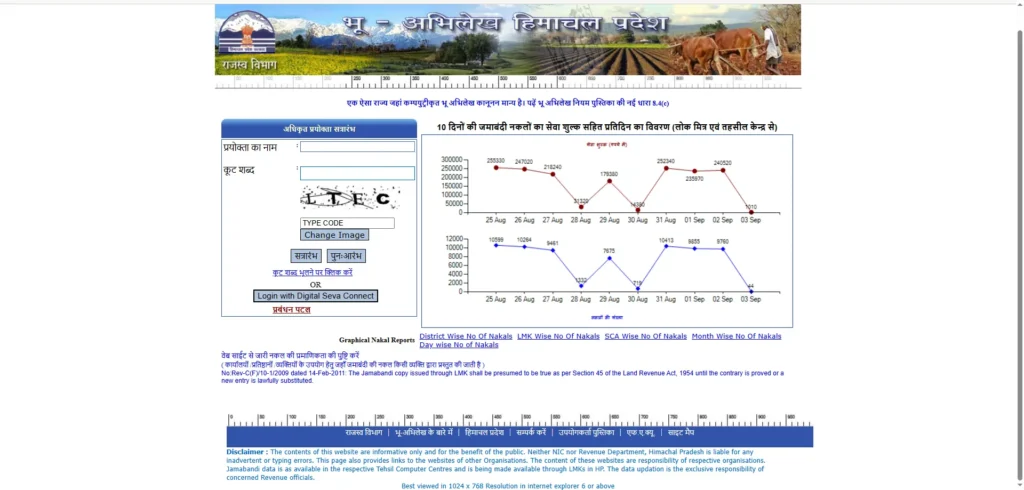
Step-by-Step: How to Check HP Land Records on the HimBhoomi Portal
Checking your land records online on the official HimBhoomi website is a straightforward process. Follow this step-by-step walkthrough to access your Jamabandi details:
- Navigate to the Official Portal: Go to the official land records website of the HP Revenue Department at
himbhoomilmk.nic.in/viewlandrecords.aspx. - Select Your Location Parameters: Use the dropdown menus to select your District, Tehsil, Village, and the correct Jamabandi Year.
- Red Flag: Always manually select the most recent year in the dropdown menu. Selecting an older cycle will return outdated ownership details, which can hide recent transfers.
- Enter the Security Verification: Type the CAPTCHA code exactly as shown on the screen and click “OK” or “Proceed”.
- Choose Your Search Index Identifier: The system allows you to search the database using one of four parameters:
- Khewat Number (Khata Number)
- Khatauni Number
- Khasra Number
- Owner’s Name
- Owner Name Search Tip: If you choose to search by the owner’s name, ensure you enter it in Unicode Hindi/Devanagari script. All back-office land database records are stored in Devanagari; entering names in English will result in a failed database query.
- Retrieve and Save: Once you click “View Record”, your detailed Nakal Jamabandi will load on the screen. You can review all columns, inspect the remarks column, and click “Save as PDF” to download a local copy.
Bhu Naksha HP: How to View and Download Land Maps Online
In Himachal Pradesh, a textual Record of Rights is only half of the property puzzle; spatial boundary verification is equally critical to prevent disputes. The state’s official cadastral mapping engine is Bhu Naksha HP, accessible at www.bhunakshahp.nic.in.
The technical architecture of Bhu Naksha is powered by GeoTools—an open-source Java GIS library—backed by a robust Postgres database that ingests shapefiles (.shp) of village land parcels. Because of Himachal’s historical measuring standards, Bhu Naksha applies a specific technical scale factor multiplier of 22 to translate digital centimeter shapefiles back into the traditional land measurement unit known as the Karam.
To view and verify your land map online:
- Visit the official Bhu Naksha HP portal.
- Select your District, Tehsil, and Village from the dropdown menu on the left panel.
- The digitized cadastral map of your village will render on the main screen.
- Click on your specific Khasra Number directly on the map, or search for it in the search bar.
- The system will pull up the “Plot Info” on the left, displaying the landowner’s name, area, and land classification.
Step-by-Step to Download a Tatima (Field Map)
A Tatima is a specialized spatial sketch map generated to record physical land subdivisions or partitions among joint owners. To download a certified Map Report:
- Select your plot Khasra on the Bhu Naksha interface.
- On the left-hand panel, click on “Map Report”.
- Select either “Single Plot” or “All Plots of Same Owner”.
- Click on “Show Report in PDF format”.
- Save or print the generated map report.
SEO Alert/User Warning: Although Bhu Naksha has digitized cadastral maps for 21,313 villages (98.6%) out of the state’s 21,631 revenue villages, only 14,980 villages (70%) are currently uploaded and live on the online portal. The remaining 30% are held offline as field staff work to resolve spatial errors.
Furthermore, the digital maps on Bhu Naksha are not geo-referenced and do not display real-time subdivisions. The official paper-cloth map (Latha or Mussavi) physically held and updated by the local Patwari remains the ultimate legal authority in boundary demarcation disputes.
MEGH Portal: Accessing Advanced Citizen Services Online
To consolidate various digital interfaces under a unified e-Governance banner, the state government rolled out the MEGH (Management of Electronic Governance of Himachal Pradesh) portal. The MEGH system is integrated with the National Generic Document Registration System (NGDRS), serving as a single window for advanced land administration tasks.
How to Submit an Online Mutation (Intakaal) Request
Mutation is the formal administrative process of updating land ownership and title in the revenue records following a sale, gift, inheritance, or partition. Follow these steps to generate a digital mutation request on the portal:
- Go to the MEGH/eHimbhoomi home screen and click on “Online Mutation Request”.
- Enter your basic contact parameters: Name, Mobile Number, and Email ID. Submit the CAPTCHA to generate an online profile.
- Fill out the mutation application form by selecting the exact Location (District, Tehsil, Village) and entering the target Khasra or Khatauni numbers.
- Select the correct Mutation Type (e.g., Sale, Gift, Inheritance/Succession, or Partition).
- Upload the necessary supporting documents:
- For Sale transactions: A registered Sale Deed copy.
- For Inheritance: A death certificate of the previous owner and a Shajra Nasb genealogy extract.
- For Gift: Registered Gift Deed.
- Submit the form and record your unique Application Reference Number to track the processing status online under the “Check Online Mutation Request” dashboard.
Applying for Land Demarcation Online
Boundary demarcations are the most common disputes handled by field revenue staff in Himachal’s complex hilly terrain. Landowners can submit an online demarcation request through eHimbhoomi:
- Click on the “MEGH – Demarcation” option on the portal.
- Fill out the online application form, clearly specifying the location coordinates and the legal reason for demarcation (e.g., boundary encroachment, construction prep, or partition).
- Upon submission, you will receive an acknowledgment receipt with a tracking number.
- The local Tehsil office reviews the document. If all criteria are met, the Field Kanungo schedules a physical field visit, conducts the measurement on-ground, and uploads a compliance report directly to the Tehsil’s database.
Bank Integration and Charge Creation Flow
One of HimBhoomi’s most impressive technological integrations is the eHimbhoomi Charge Creation Module. This module links commercial banking portals directly to the land records system. When a farmer or property owner applies for a loan (such as a Kisan Credit Card) using their land as collateral, the system handles the bank charge digitally:
This dual-layered verification ensures that any loan liability or lien is permanently recorded in red ink in the remarks section of the Jamabandi, protecting future buyers and securing the bank’s collateral interests.
Structural Bottlenecks in HimBhoomi: What Property Buyers Must Know
While HimBhoomi has significantly increased citizen convenience, property buyers in Himachal Pradesh must be aware of several systemic bottlenecks that can hide title defects:
1. The Cyclical Daur Bottleneck
Himachal Pradesh operates on a legacy five-year Daur (cycle) system. Under this system, when a property transaction occurs and a mutation is formally approved, the name of the new owner is not immediately updated in the primary “Owners Column” (Column 4) of the Jamabandi. Instead, the transaction details sit in the “Remarks Column” (Column 12).
The primary owners column is updated only when the five-year Daur cycle is completed and the entire land record of the village is rotationally re-compiled. Currently, S3waas evaluation data reveals that 84% of all villages in Himachal are in the middle of active Daur updates, while another 16% have a backlog where records have remained un-updated for two or more Daurs (over 10 years).
The Danger for Buyers: Because the main ownership column remains outdated for up to five years, the state’s registration software (NGDRS) cannot auto-detect the name of the current owner from live records. Buyers must manually cross-reference Column 12 remarks to ensure the seller has not already transferred the land to someone else during the active Daur cycle.
2. Bypassed Automation and High Mutation Pendency
In 2011-2012, Himachal Pradesh attempted to transition to auto-mutation post-registration. However, the trial bypassed physical Patwari verification, leading to catastrophic errors—including the automated mutation of properties that had active court stay orders.
The state reversed this trial and returned to a manual, workflow-based mutation pipeline that requires hands-on Patwari field verification. Due to staffing shortages, procedural delays, and family inheritance disputes, this manual checking process has resulted in a staggering 77% pendency rate for mutation applications over recent fiscal years, leaving over 92,000 online applications stuck in limbo.
3. Departmental Silos and Outdated Spatial Data
Despite digitized maps on Bhu Naksha, textual land records (eHimbhoomi) and spatial mapping registries continue to operate in departmental silos. Approved land subdivisions (Tatimas) are updated on the Patwari’s physical cloth map (Latha) but can take months or years to reflect on the online Bhu Naksha GIS portal.
Furthermore, historical cadastral maps prepared between 1908 and 1911 utilized the outdated chain survey method, which is mathematically inconsistent with modern Electronic Total Station (ETS) or Global Positioning System (GPS) surveys. Attempting to correct these legacy maps with modern GPS tools often results in severe area mismatches, sparking widespread boundary disputes and citizen objections. S3waas data indicates that 78% of digital records in Maharashtra, 68% in Rajasthan, and 65% in Himachal Pradesh show spatial area discrepancies compared to physical realities on the ground.
The Legal Framework for Property Buyers in Himachal Pradesh
Buying land in the Himalayas is heavily regulated to protect local heritage, ecological balance, and small agricultural holdings from exploitation.
Section 118 of the HPTLR Act: Who Can Buy Property?
The most critical legal hurdle for outsiders is Section 118 of the Himachal Pradesh Tenancy and Land Reforms Act of 1972. This protective statute strictly prohibits “non-agriculturists”—defined as anyone who does not own and cultivate land in Himachal Pradesh—from purchasing agricultural land within the state.
Outsiders can only purchase land under very strict statutory exemptions:
- Bona Fide Residents: Only local Himachali agriculturists can buy agricultural land freely.
- Prior State Government Permission: Non-residents intending to buy land for residential, industrial, or commercial use must apply for and obtain explicit Section 118 permission from the state Cabinet. This approval is conditional and must be utilized within a strict two-year window.
- Built-up Structures Exception: Non-agriculturists can purchase or rent built-up apartments, flats, or commercial structures without the underlying land, provided the property falls within the jurisdiction of a municipal corporation, municipal committee, cantonment board, or notified area committee.
HP Circle Rates & Category-Based Stamp Duties
When registering a property transaction, stamp duties and registration fees are calculated based on the Circle Rates annually notified by the district administration. These rates are highly sensitive to road proximity, with the state dividing all land parcels into three distinct categories for duty valuation:
- Category-I (Abuts Road directly): Property directly touches a public road. Valuation is set at 100% of the notified circle rate.
- Category-II (Within 50 meters of Road): Land parcel is within 50 meters of a public road. Valuation enjoys a 25% reduction from the Category-I rate.
- Category-III (Beyond 50 meters of Road): Property is further than 50 meters from a public road. Valuation enjoys a 50% reduction from Category-I.
2024 Circle Rate Ranges for Major Districts (Per Sq. Ft.)
- Shimla: Rs. 6,972 to Rs. 17,917
- Solan: Rs. 280 to Rs. 11,730
- Mandi: Rs. 156 to Rs. 20,080
- Kangra: Rs. 227 to Rs. 15,422
- Kullu: Rs. 174 to Rs. 10,608
The standard Stamp Duty for property sales, gifts, and mortgages with possession in Himachal Pradesh is set at 5% of the transaction value or the circle rate valuation (whichever is higher), while the Registration Fee is 2% of the value (capped at a maximum of Rs. 25,000).
Promotional Rebates & Exemptions:
- Ex-Servicemen: Former service members who invested three or more years in the union armed forces are completely exempted from stamp duty for land registry.
- New Industries: To boost economic growth, the state provides a 50% rebate on stamp duty for newly registered industrial projects.
Property Exchanges Under Transfer of Property Act Section 118
Often, family members or local landowners choose to swap parcels rather than execute straight cash sales. Under Section 118 of the Transfer of Property Act of 1882, property exchange occurs when two parties mutually agree to trade ownership of one immovable asset for another.
When registering an exchange deed, the principal stamp duty is assessed at 5% of the property with the higher market value, accompanied by a 0.8% registration fee. These costs are mutually decided and paid by the participating parties. These transactions also allow landowners to claim capital gains tax exemptions under Section 54 of the Income Tax Act of 1961, provided they acquire another residential house within one year before or two years after the transfer date.
Empowering Women through Promotional Property Incentives
Gender disparities in asset ownership remain a persistent challenge in the state. According to National Family Health Survey (NFHS-5) data, only 42.3% of women aged 15-49 in Himachal Pradesh own a house alone or jointly, and only 31.7% own land under similar terms.
To bridge this asset gap, the Himachal Pradesh government utilizes progressive tax incentives to encourage property registration in women’s names:
- Reduced Stamp Duty for Women: Property transactions registered solely in the name of a female buyer enjoy a promotional stamp duty rate of 4% (compared to 6% for males).
- Equal Inheritance Rights: The 2005 coparcenary amendments to the Hindu Succession Act of 1956 guarantee equal ancestral property inheritance rights for daughters, which is systematically documented via family genealogical trees (Shajra Nasb).
How to Use the mHimBhoomi Mobile App
To provide on-the-go access to land records, the National Informatics Centre launched the official mHimBhoomi mobile application, available on Android Google Play and Apple iOS.
The mobile app provides several useful features:
- Quick Land Search: View Jamabandi extracts based on Khewat, Khatoni, or Khasra numbers.
- Seeded Aadhaar Search: If landowners have seeded their Aadhaar numbers with their land accounts, they can retrieve all associated property holdings with a single search query.
- Shajra Nasb View: Tracing family trees and genealogy records directly from your screen.
- Offline Saving: Land records once accessed are automatically cached locally under “Saved Records” for offline access when traveling through remote mountain regions with poor connectivity.
App Store Usability Limitations
While convenient, users must note that the mHimBhoomi app currently holds a modest 3.0 to 3.5-star rating due to several documented bugs:
- iOS Interface Issues: iPhone users frequently report that the search bar under the “Shajra Nasb” module fails to retrieve family names.
- Dropdown Errors: During peak server traffic, location dropdown menus (District, Tehsil, Village) can render empty, blocking searches entirely.
- PDF Downloading Glitches: Clearing the system cache is frequently required as the download button often redirects users to a generic home screen error.
Frequently Asked Questions (FAQ) about HimBhoomi
How often are land records updated on the HimBhoomi portal?
While intermediate ownership changes (mutation entries) are logged in the remarks column in red ink as they are approved, the primary “Owners Column” is updated only every five years under the rotational Daur compiling system.
Can I download a legally valid Jamabandi from my home computer?
Yes, but only under the updated 2026 digital system. Legally certified copies with digital signatures and QR codes can now be downloaded after paying a nominal fee of Rs. 20 to Rs. 50 on the portal. However, because localized backlogs occasionally cause digital records to diverge from physical realities, double-verifying through a certified copy obtained from a local Lok Mitra Kendra or Tehsil office (at Rs. 5 per Khatauni holding) remains highly recommended.
Can an outsider purchase agricultural land in Himachal Pradesh?
No. Section 118 of the HPTLR Act strictly prohibits non-agriculturists from purchasing agricultural land without prior, specific approval from the state government Cabinet. Outsiders are generally limited to buying built-up flats or commercial structures in municipal areas.
What is the significance of “red ink entries” in Column 12 (Remarks)?
Column 12 is the most critical area for due diligence. Any entry written in red ink indicates an active mortgage, an outstanding bank loan, a pending mutation, a civil litigation dispute, or a court-ordered stay. Buyers must demand a formal discharge or clearance certificate from the seller if Column 12 contains active remarks.
What is the difference between Khewat and Khatauni numbers?
A Khewat number (or Khata number) is an account number assigned to a group of co-owners who jointly own a specific landholding. A Khatauni number indicates the specific family or cultivating tenant who is in physical possession of a particular khasra plot within that joint holding.
Due Diligence Checklist for Property Buyers
Before hand-delivering any token money to a seller in Himachal Pradesh, verify the following parameters to protect your investment:
- Verify Column 12 Remarks: Check for red ink entries indicating active mortgages, pending mutations, or active civil litigations.
- Cross-Verify Owner Names in Devanagari: Search Himbhoomi using the owner’s exact Devanagari name to prevent database query failures.
- Inspect the Khasra on Bhu Naksha HP: Ensure the map boundary, shape, and area match the physical parcel on the ground.
- Confirm Joint Consent: If the land is held jointly (Khewat), ensure all co-owners have signed a partition deed or formal no-objection certificate.
- Verify Road Proximity Category: Double-check whether the property falls under Category I, II, or III to calculate accurate circle rates and stamp duties.
- Ensure Section 118 Compliance: If you are an outsider, secure official Cabinets permission before executing any deed registration.
Disclaimer: Land governance, circle rates, and fee matrices are subject to dynamic regulatory updates by the Revenue Department. Always cross-verify critical title entries at the local Sub-Registrar Office before completing any transaction.