The management of land records in Jharkhand has undergone a massive digital transformation, culminating in the fully integrated Jharbhoomi ecosystem. Developed by the Department of Revenue, Registration and Land Reforms, Government of Jharkhand, in active collaboration with the National Informatics Centre (NIC), the Jharbhoomi portal serves as the central digital highway for all land-related administrative actions in the state. From viewing your Record of Rights (RoR) to processing land mutations, tracking pending cases, and paying land revenue taxes, everything has been unified under a single-window system designed to simplify citizen interactions and maximize transparency.
However, navigating the digital land records landscape requires caution. With the rise of digital search volumes, several unauthorized, third-party cloned websites—most notably operating under domains such as jharbhoomi.com or jharbhumi.com—have emerged. Citizens must understand that the only official and secure portal for Jharkhand land records is https://jharbhoomi.jharkhand.gov.in. Furthermore, the Government of Jharkhand has explicitly confirmed that there is no official Jharbhoomi mobile application. Residents and buyers are strongly advised to refrain from entering sensitive personal details or downloading suspicious third-party apps from public stores, which are not government-affiliated and can compromise data privacy
While this digitisation drive has brought immense convenience, it also carries structural complexities. When the state first digitised its registries, over 99% of legacy textual land records were migrated to the online portal. However, only a tiny fraction (roughly 2.3%) of these lands had been physically surveyed on the ground during the fast-paced transition. This created a critical “data-reality gap” where unverified legacy errors, typographical mistakes, and unrecorded land divisions were locked into the central database, occasionally leaving genuine landowners struggling with unverified records. This guide provides a comprehensive blueprint to safely checking, verifying, paying, and rectifying your land records on Jharbhoomi in 2026.
What is Jharbhoomi? Official Jharkhand Land Records Portal Overview
Established under the auspices of the Digital India Land Records Modernisation Programme (DILRMP), Jharbhoomi was launched in 2016 to systematically digitize all revenue and registration records across Jharkhand’s 24 districts. The primary, long-term administrative target of the DILRMP is to shift land management from the traditional, presumptive deed-registration system (where registration merely documents a transaction) to a modern, conclusive titling framework featuring state-guaranteed property ownership.
To achieve this conclusive titling system while maintaining database stability, the state operates Jharbhoomi as a modular ecosystem. Rather than routing all traffic through a single web server, different administrative tasks are partitioned across several dedicated portals:
| Functional Sub-Portal | URL Address | Core Administrative Operations |
|---|---|---|
| Jharbhoomi Main Portal | jharbhoomi.jharkhand.gov.in | Serves as the central repository for the Record of Rights (RoR), online mutation tracking, Register-II enrollment, and land classification data. |
| JharBhuNaksha | jharbhunaksha.jharkhand.gov.in | A Geographic Information System (GIS) engine storing digitized cadastral maps and plot boundaries linked directly to textual records. |
| JharBhuLagan | jharbhulagan.jharkhand.gov.in | The state’s dedicated land revenue portal, enabling taxpayers to review outstanding land rents, evaluate arrears, and process payments. |
| Parishodhan | parishodhan.jharkhand.gov.in | A specialized digital rectification portal designed for correcting data entry errors in digitized Khatian and Register-II entries. |
| JharSewa | jharsewa.jharkhand.gov.in | A multi-service administrative portal constructed on the ServicePlus framework for issuing digitized caste, income, and residence certificates. |
| JharNibandhan (NGDRS) | jharnibandhan.gov.in | An API-driven portal integrating the National Generic Document Registration System with local Circle Offices for real-time document registration. |
Purpose and Core Objectives of the Jharbhoomi Land Record System
The consolidation of land records under the Jharbhoomi umbrella is driven by critical administrative objectives:
- Minimizing Litigation and Land Disputes: Land disputes represent approximately 60% of all Indian court civil cases. By providing clear, public, and verifiable ownership histories, the portal acts as a vital tool to reduce fraudulent transactions and boundary litigation.
- Eliminating Intermediaries: The single-window system enables direct citizens, buyers, and sellers to access documents instantly, eliminating reliance on intermediaries or administrative delays.
- Fostering Conclusive Titling: Linking textual records (Records of Rights) with spatial data (cadastral maps) helps build a legally secure database of land boundaries and titles.
- Enabling Economic Access: Land is a primary economic asset. Providing verified, digital land titles enables landowners to easily use their property as collateral to secure bank credit and development loans.
Why You Should Periodically Verify Your Jharkhand Land Records Online
Even if you have no immediate plans to sell your property, periodic verification on Jharbhoomi is an essential best practice for property hygiene. Landowners must verify records for several reasons:
- Verifying Mutation Status: Ensure that property transfers after a transaction, partition, or inheritance have actually been successfully recorded in the state’s revenue logs.
- Securing Bank Credit & Farm Loans: Financial institutions and banks in Jharkhand strictly require an updated, verified land record extraction (such as Register-II) before processing mortgage or crop-backed loans.
- Pre-Purchase Due Diligence: Prospective buyers must verify the chain of title, identify hidden co-sharers, and confirm physical boundaries before committing any funds to a transaction.
- Accessing Government Schemes: Verified land record databases serve as the foundational dataset for identifying direct beneficiaries under various state and central agricultural subsidy programmes.
Understanding Key Land Revenue Terms in Jharkhand
To navigate Jharbhoomi effectively, you must understand the local terminology used in Jharkhand’s revenue administration, which draws heavily from historical tenancy frameworks.
What is a Khatiyan (Apna Khata / RoR)?
The Khatiyan (also referred to as Apna Khata or Record of Rights) is the foundational revenue document maintained under the Jharbhoomi portal. Governed by the Bihar Tenancy Act and Chota Nagpur Tenancy Act, the Khatiyan records the current possessor, land classification, area, unique plot numbers, and rights attached to every parcel of land in the state. It contains fields for the unique Khatian number, survey plot numbers, the name of the possessor, co-sharer proportions, a description of the rights (e.g., raiyati), and any superior interests (such as government claims).
- Crucial Judicial Reality: It is a settled legal principle, repeatedly upheld by the Patna and Jharkhand High Courts, that a Khatiyan entry is a revenue record and does not by itself create or destroy ownership title. Legal ownership is established solely by a registered title deed (Mula Deed) verified through
jharnibandhan.gov.in. The Khatiyan serves as a cross-reference for revenue purposes, not a definitive title certificate.
What is Register-II (Panji-II)?
Register-II (Panji-II or पंजी-II) is the official tenant ledger maintained at the block level under the supervision of the local Circle Officer (Anchal Adhikari). Register-II contains a separate page for each tenant/landholder and contains crucial details such as the owner’s name, khata number, khasra (plot) number, land area, the mutation case history, outstanding land tax, and the Jamabandi number. Banks require Register-II verifications because it lists active, updated encumbrances and mutations.
Khasra, Khata, and Khewat Numbers Explained
- Khasra / Khesra (Plot Number): The unique survey or identification number assigned to an individual land parcel within a specific revenue village. In urban zones, the Khasra number functions as the municipal plot or survey number.
- Khata Number: The account number allocated to a family or collective of individuals by the revenue department, representing their total undivided land holdings in a particular locality.
- Khewat Number (Khewat/Khewat Number): The account number assigned to co-shareholders who hold equal or varying proportions under a single, shared ancestral landholding.
Step-by-Step Guide: How to Check Land Records on Jharbhoomi
Checking your Record of Rights online is straightforward, free of cost, and can be completed from any desktop browser. Before starting, make sure you have the exact district, block, halka, mauza, and plot details on hand.
Step 1: Navigating the Jharbhoomi Homepage
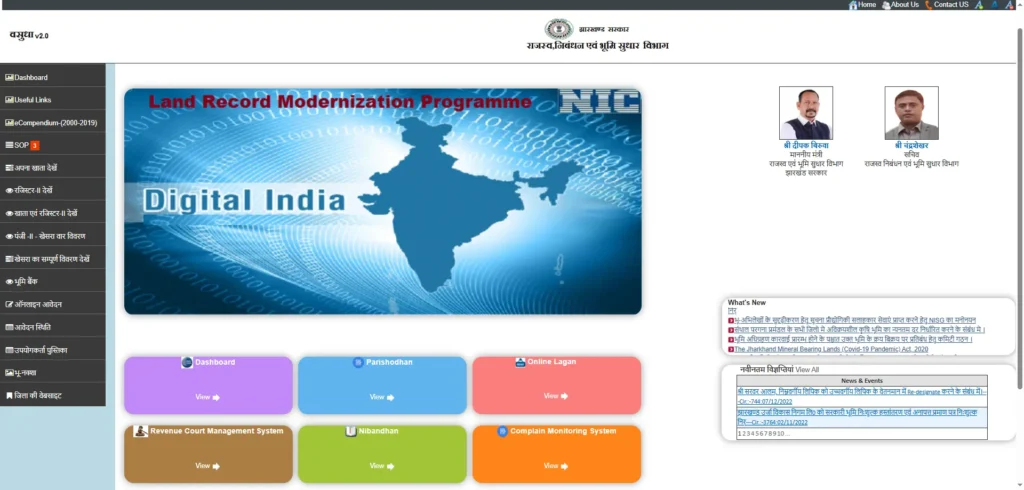
Open your browser and visit the official Jharbhoomi portal: https://jharbhoomi.jharkhand.gov.in. On the left-hand navigation column, click the tab labeled “Check Your Account” (or “View Your Account”).
Step 2: Selecting the District on the Interactive Map
The portal will redirect you to an interactive digital map displaying all 24 districts of Jharkhand. Hover and click on the specific district where the property or land parcel is physically situated.
Step 3: Choosing the Block and Anchal
Once the district is selected, a detailed sub-district map will load on your screen. Click on the specific Block/Anchal (Revenue Circle) relevant to your land parcel to narrow down the dataset.
Step 4: Entering Halka and Mauza Details
The portal will open the search input screen. From the dropdown menus, select:
- Halka (The smallest administrative circle under a revenue officer).
- Land Type (Specify whether the land is Raiyati, Gair-Mazarua, Khas Mahal, etc.).
- Mauza (The administrative village name from the scrollable list).
Step 5: Searching by Khata, Khesra, or Owner Name
You can locate and load your specific Khatiyan document using one of several search parameters:
- Search by Mauza Name: Displays all land holdings registered under the selected village.
- Search by Khata Number: Enter the family account number directly.
- Search by Khesra Number (Plot Number): Enter the survey plot number to view a specific parcel.
- Search by Account Holder Name: Input the owner’s name (first, last, or short name searches are supported).
Once you select your search criteria, enter the security CAPTCHA code exactly as shown on the screen and click “Search Account” (or “Khatian”). The portal will instantly generate your Record of Rights showing the Khatian number, possessor details, land type, and plot dimensions, which you can print or download directly as a PDF.
JharBhuLagan: Paying Your Land Tax (Lagan) Online
Under Jharkhand law, all landowners must pay annual land revenue taxes, traditionally called Lagan (or Lagaan). The state has consolidated lagan assessments and receipt generation online through the JharBhuLagan sub-portal.
How to Check Outstanding Lagan and Arrears Online
- Go to the official JharBhuLagan portal:
https://jharbhulagan.jharkhand.gov.in. - On the home interface, click the option titled “See Arrears” (Bakaya Dekhein).
- Enter your District, Anchal, Halka, Mauza, and input your Khata, Khesra, or Raiyat name.
- Solve the security CAPTCHA and hit “Search” to view your up-to-date outstanding dues and arrears on the screen.
Settle Your Lagan Online via JharBhuLagan
- To make a payment, click the “Pay Online” option under the JharBhuLagan dashboard.
- Verify your location details, search for your property ledger, and view your tax details.
- Click the “Online Bhugtan Karein” (Make Online Payment) tab.
- Select your preferred secure online payment gateway (UPI, Net Banking, or Credit/Debit Cards) and complete the transaction.
- Critical Best Practice: Always download and print your generated digital land tax receipt (Jamin Rasid). This document is legally mandatory for completing mutations, securing credit, or presenting titles in legal proceedings.
Dakhil Kharij: Applying for Land Mutation in Jharkhand
When land changes hands due to a sale, inheritance, partition, or gift, updating the state’s Register-II is legally mandatory. This administrative process is known as Dakhil Kharij (or Land Mutation).
Why Land Mutation is Mandatory After Registration
Many buyers assume that registering a sale deed at the sub-registrar office is the final step in securing land ownership. However, registration and mutation are entirely separate legal actions.
- Registration documentarily transfers legal title between parties.
- Mutation (Dakhil Kharij) updates Register-II (the revenue records) to replace the seller’s name with the buyer’s name.
Until the local Circle Officer formally approves your mutation application, the seller remains the recorded landholder in the government’s books. Consequently, you cannot pay land tax in your name, cannot legally resell the property, and cannot secure bank financing.
Online Land Mutation Application Process on Jharbhoomi
- Visit the Jharbhoomi homepage and click the “Online Application” link on the left panel.
- Register as a new user with your personal details, email, and mobile number, or log in if you are already registered.
- Select your District and Circle (Anchal) from the dropdown menus.
- Click the link labeled “Apply New Mutation”.
- Under the application form, fill in the applicant details, buyer details, seller details, and plot coordinates. Under the mutation type, specify “By Sale” (or “Inheritance/Succession” as applicable).
- Upload scanned, high-quality copies of the required documents, which include your registered sale deed, ID proofs (Aadhaar or Voter ID), and a stamp paper affidavit of requisite value.
- Submit the application, write down your auto-generated Mutation Case/Acknowledgement Number, and download the submission receipt.
Tracking Jharbhoomi Mutation Status Online
Once submitted, your application is electronically routed to the revenue inspector’s dashboard. You can track its progress:
- Click the “Application Status” tab on the Jharbhoomi panel.
- Click your specific block on the interactive sub-district map.
- Select the District, Anchal, and Year Session.
- Filter by Case Number, applicant’s name, or Mauja.
- The portal will display real-time statuses (e.g., Pending, Approved, Objected, or Rejected). Online mutations typically take 15 to 30 days depending on the circle’s workload.
What to Do if Your Mutation Application is Rejected?
Previously, a major loophole allowed applicants to repeatedly submit the same application if a Circle Officer (CO) rejected it. This generated administrative clutter.
- The 2026 Land Governance Rules: Under updated rules, a CO’s rejection is now considered final at the circle level. If your mutation is denied, you must file a formal appeal with the Deputy Collector Land Reforms (DCLR).
- This appeal process ensures that every rejection is reviewed by a higher administrative authority, protecting citizens from arbitrary denials by local officers. Additionally, rejections are flagged in the official performance review of the CO to enforce legal accountability.
JharBhuNaksha: Viewing and Downloading Land Maps Online
To confirm physical land layout and prevent boundary encroachments, citizens can access georeferenced cadastral maps online via JharBhuNaksha.
How to View Interactive Cadastral Maps by Plot Number
- Open the official Bhu Naksha portal:
https://jharbhunaksha.jharkhand.gov.in - On the left selection pane, input your District, Circle, Halka, Mauza, and Sheet Number.
- The interactive map of the village will load on your screen.
- Locate your specific plot number.
- Interactive Inquiry: Clicking on any plot immediately highlights its boundaries, displays its exact size, and lists the registered owner’s name under “Plot Info” on the left panel.
Download Bhu Naksha PDF for Offline Reference
- Under the highlighted Plot Info section, click the link titled “Map Report”.
- The portal will generate a georeferenced, print-ready cadastral layout of the plot and adjacent boundaries.
- Under the DILRMP system, maps are fully integrated with textual records, allowing users to validate digital signatures directly on the PDF. Click “Print” or “Download as PDF” for reference during transactions.
Parishodhan Portal: Correcting Digital Land Record Errors
Typographical errors are commonplace in digital databases. To streamline corrections, the state government launched Parishodhan.
Why Digital Errors Occurred: Private Data Entry Gaps
Typographical and alignment errors were largely introduced between 2008 and 2016. The state government appointed private data-entry agencies to manually transcribe historical paper records into the digital database. Typists unfamiliar with complex local names frequently made spelling errors, mixed up adjacent plot sizes, or omitted decades of legacy succession and mutation transfers. This generated discrepancies between on-the-ground possession and Jharbhoomi’s database.
Submitting a Grievance on the Parishodhan Portal
To correct digital errors without making countless trips to government offices, follow this rectification process:
- Open the official Parishodhan portal:
https://parishodhan.jharkhand.gov.in. - Click the link titled “Post Grievance”.
- Select your type of rectification:
- Correction in the name/address of the raiyat.
- Correction in Khata, Khesra, or area (Rakba) figures.
- Correction in Lagan assessment amounts.
- Enrolling missing Jamabandi/Khatian records omitted during digitization.
- Input applicant details and generate an OTP (One-Time Password) to verify your mobile number.
- Complete the complaint details, entering the incorrect Jharbhoomi entries and the correct historical figures.
- Upload Support Documents: Scanned copies of your original legacy Khatians, registered title deeds, and historical land tax receipts are mandatory.
- Submit the form to receive a trackable grievance ID. The application is electronically flagged on the concerned Circle Officer’s dashboard and remains marked as “pending” until resolved, ensuring accountability.
Crucial Legal Safeguards for Jharkhand Property Buyers
Property transactions in Jharkhand carry significant legal risks due to historical tenancy protection laws that do not always appear clearly on the Jharbhoomi portal.
Tribal Land Protection and the Chota Nagpur Tenancy (CNT) Act
The Chota Nagpur Tenancy (CNT) Act of 1908 (and the Santhal Pargana Tenancy Act) is a landmark statute enacted to prevent the displacement of Jharkhand’s tribal population.
- Transfer Restriction: Section 46 of the CNT Act strictly prohibits the transfer, sale, gift, or mortgage of lands belonging to Scheduled Tribes (ST), Scheduled Castes (SC), and Other Backward Classes (OBC) to non-tribals.
- Deputy Commissioner’s Permission: Land transfers between members of the same community can only occur with prior, explicit, written clearance from the district’s Deputy Commissioner (DC).
- Out-of-State Buyers: Non-resident OBC or general category buyers from outside Jharkhand are completely barred from purchasing CNT-protected land.
The Risk of Relying Solely on Jharbhoomi
Because early digitization was completed without physical ground verification, tribal raiyati land is occasionally mislabelled as general, transferable land on Jharbhoomi.
- Eviction Risk: If an outsider purchases CNT-protected land without DC permission, the transaction is considered null and void from inception. Under Section 71A of the Act, the DC has absolute authority to evict the non-tribal purchaser and restore physical possession to the original tribal owner, even decades after the transaction.
- Key Judicial Precedents:
- Arthor Capton vs. State of Jharkhand (2024 Supreme (Jhk) 350): Confirmed that Section 46 violations are void ab initio; no subsequent registration or construction can validate the title.
- Mahendra Singh vs. State of Jharkhand (2004 Supreme (Jhk) 931): Established that because of strict CNT restrictions, non-tribals cannot claim ownership over tribal land through 12-year adverse possession if the initial transfer violated Section 46.
The Rule of Thumb for Buyers: Never purchase property in Jharkhand based on Jharbhoomi printouts alone. Buyers must manually check the original, historical paper-based legacy deeds to confirm the land’s original classification.
Addressing Incomplete Records in Rural Blocks: Filing an RTI
In several rural blocks of Ranchi district (such as Tamar, Bundu, Namkum, Sonahatu, and Chanho), online records on Jharbhoomi are incomplete, outdated, or static due to pending CNT compliance checks.
- The RTI Route: Under Section 6 of the Right to Information (RTI) Act 2005, citizens can submit an application with a nominal fee of Rs. 10 to the concerned block’s Circle Officer (the Public Information Officer).
- What to Request: Request certified extracts of the legacy, paper-based Khatian, the current status of the CNT compliance check, and the name of the verifying officer. Documenting the transaction trail via RTI often speeds up pending mutations that are delayed solely due to administrative bottlenecks.
Jharbhoomi FAQ
Is there an official Jharbhoomi Mobile App?
No. The Government of Jharkhand has not released an official mobile app for Jharbhoomi. All applications available on the Google Play Store or Apple App Store are third-party apps. Users are advised to avoid sharing confidential credentials or property details on these apps.
What is the difference between registration and mutation in Jharkhand?
Registration at the sub-registrar office documents and registers your sale deed, creating an official record of the transaction. Mutation (Dakhil Kharij) is the subsequent, separate step where the Circle Officer updates Register-II (the revenue records) to list you as the taxpayer. Both are mandatory.
Is accessing land records on the Jharbhoomi portal free?
Yes. Viewing and downloading Apna Khata, Khatian, Register-II, and Bhu Naksha details on Jharbhoomi is completely free of cost. However, obtaining certified, officially stamped copies of these documents requires a minor fee at the local Circle Office.
What should I do if my land map is unavailable on JharBhuNaksha?
If your plot map is not visible online, it means the local revenue administration has not yet uploaded the georeferenced data for that specific Mauza. In such cases, you must physically visit your local Circle Office or the Tehsil office to request a certified physical copy of the legacy cadastral map.
What is the official website URL of the Jharbhoomi portal?
The only official portal of the Revenue, Registration and Land Reforms Department of Jharkhand is https://jharbhoomi.jharkhand.gov.in. Avoid clicking on unofficial lookalikes ending in .com.
Disclaimer: The information provided in this guide is for educational and informational purposes only. Land and property laws are complex and depend on individual facts, community customs, and specific jurisdictions. Always consult a qualified advocate well-versed in the CNT Act 1908 and Jharkhand land revenue practices before entering into real estate transactions.