
Navigating land administration in the beautiful Himalayan state of Sikkim requires a deep understanding of unique legal frameworks, historical tenure classifications, and modern digital portals. Whether you are a citizen verifying ancestral holdings, a property lawyer performing title research, or an investor scouting for eco-tourism opportunities, understanding the Sikkim Land Records system is paramount.
Under the Digital India Land Records Modernization Programme (DILRMP), the Government of Sikkim has digitised its land revenue records to enhance transparency and security. Today, portals such as the Integrated Land Record Management System (ILRMS), Dharitri, and Bhu Naksha have replaced cumbersome manual ledger lookups with streamlined, instant online verifications.
This comprehensive guide serves as your definitive manual for searching, verifying, and downloading land records in Sikkim, while also mitigating transactional and legal risks in this highly regulated land market.
Understanding Sikkim’s Unique Land Laws under Article 371F
Property transactions in Sikkim are fundamentally different from those in the rest of India. When Sikkim merged with the Indian Union in 1975, it did so under specific constitutional guarantees designed to preserve its distinct identity, culture, and social fabric.
Who is Eligible to Buy Land in Sikkim?
Under Article 371F of the Constitution of India, the pre-merger laws of Sikkim are protected and continue to remain in force. The most critical implication of this framework for the real estate sector is that only individuals holding a Sikkim Subject Certificate (SSC) or a Certificate of Identification (COI) are legally eligible to purchase or acquire land in Sikkim.
For non-Sikkimese buyers or institutional investors from other states, buying freehold land is legally prohibited. Any surrogate arrangements—such as purchasing land via a power of attorney, executing unregistered lease agreements for agricultural holdings, or entering into “benami” (proxy) transactions where a local COI holder acts as the nominal owner—are legally void and carry severe penalties. Non-Sikkimese individuals and businesses can, however, rent commercial or residential spaces or acquire leasehold rights in specified urban zones for commercial projects, subject to strict government clearances.
Protected Indigenous Lands & Revenue Order No. 1
Even among local COI holders, land transfers are subject to strict community-based protections:
- Revenue Order No. 1 of 1917: This historic law prevents the transfer or sale of land belonging to the indigenous Bhutia and Lepcha (BL) communities to any non-Bhutia or non-Lepcha individual, including other Sikkimese citizens (such as the Nepalese community).
- Restricted Transfers: Lands designated under Revenue Order No. 1 can only be transferred within the Bhutia-Lepcha community. This ensures that the ancestral holdings of Sikkim’s primary indigenous groups are protected from displacement and demographic changes.
- SDM Clearance: Any land transfer in Sikkim requires a formal “No Objection Certificate” (NOC) and clearance from the respective Sub-Divisional Magistrate (SDM) or District Collector (DC) to verify that the transaction does not violate Revenue Order No. 1 or other community-based protection laws.
Sikkim Land Record Portal: Navigating ILRMS and Dharitri
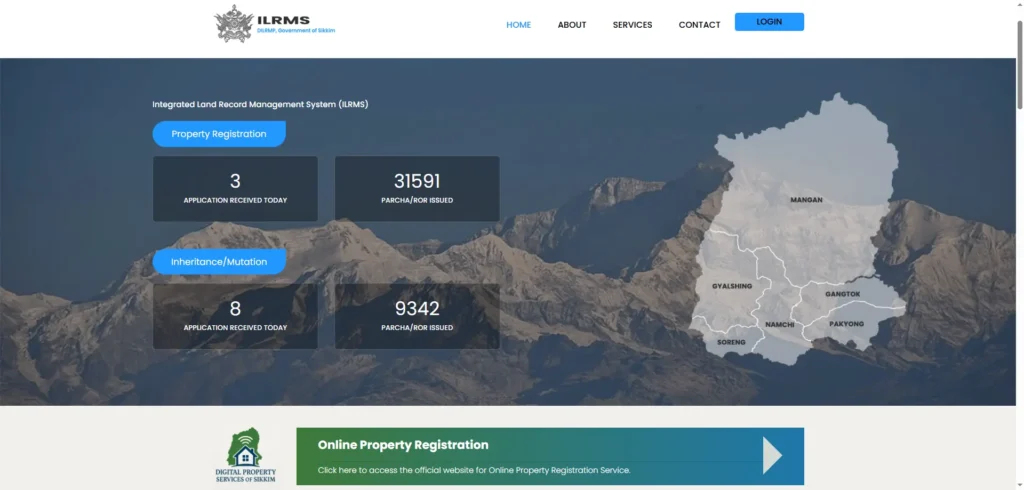
To bring order, transparency, and speed to land transactions, the Land Revenue and Disaster Management Department of Sikkim has established a unified digital infrastructure. The primary gateway for these services is the official Sikkim Land Records Portal accessible via ilrms.sikkim.gov.in.
Key Components of the Integrated Land Record Management System (ILRMS)
The ILRMS Sikkim portal acts as an umbrella platform that integrates several key databases and subsystems, ensuring that land administration, registry, and taxation are fully synchronised:
- Dharitri (Land Records Database): This is the core repository of all digitised land records in the state. Dharitri stores the complete ledger of ownership details, plot sizes, unique land identifications, and historical revenue assessments. When you perform a land record search by name or plot number, the portal queries the Dharitri database in real-time.
- e-Panjiyan (Property Registration Portal): Property registration in Sikkim is initiated online via
registry.sikkim.gov.in. This subsystem manages the workflow of deed submissions, document uploads, fee payments, and scheduling appointments for physical execution before the Sub-Registrar. - Online Land Revenue Collection System: This module allows landowners to calculate and pay their annual land revenue (Lagan) online. Paying lagan regularly is crucial, as the portal generates digital land revenue receipts that act as primary evidence of active possession and non-default status during property transactions.
- No Objection Certificate (NOC) System: Under Section 21A of the Registration Act (as applicable to Sikkim), obtaining an official NOC is mandatory before registering any sale deed. The NOC module workflow tracks family consents, panchayat recommendations, and boundary holder clearances.
Tracking on the Go: The “Sikkim Bhumi” Mobile App
Recognising that many rural landholders and field surveyors require access to records on the spot, the Government of Sikkim supported the launch of the Sikkim Bhumi mobile application (published under package name mm.marsman.sikkimbhumi). This app provides mobile access to:
- Real-time ownership verification.
- Checking the active status of land mutations (Dakhil Kharij).
- Viewing basic plot specifications directly from the Dharitri database.
- Accessing contact directories of regional revenue officers (Patwaris and Revenue Inspectors).
How to Search Land Records by Name in Sikkim: Step-by-Step
Searching for land records by name or identifying plot details is the vital starting point of any property transaction due diligence. The official online search process has been designed to be accessible to both technical and non-technical users.
Step-by-Step Process for Online Verification on ILRMS
To locate land records online, follow this detailed universal workflow:
- Access the Portal: Open your web browser and navigate to the official portal:
ilrms.sikkim.gov.in. Always verify that you are using a secureHTTPSconnection. - Navigate to Information Services: On the home page, look for the section labeled “Know Your Property”.
- Enter Location Parameters: The system organizes land records hierarchically. You will need to select the following from sequential drop-down menus:
- District: (e.g., Gangtok, Pakyong, Namchi, Soreng, Mangan, or Gyalshing).
- Sub-Division: The administrative subdivision overseeing the block.
- Revenue Circle: The specific circle block managed by the regional revenue officer.
- Revenue Block / Village: The exact village or revenue block where the land is physically located.
- Select Search Criterion: The portal allows you to search using three different parameters:
- Plot Number (Khasra Number): If you know the exact cadastral plot identifier.
- Khata / Account Number: The revenue account identifier under which the owner’s holdings are grouped.
- Owner / Landholder Name: If you do not have the numeric identifiers, choose this option and type the registered owner’s name. It is recommended to use partial name matches if spelling variations exist.
- View and Export Record: Once the system matches your query, it will display the active Khatiyan Parcha on your screen. You can download this as a PDF or print it for preliminary verification.
What is a Khatiyan Parcha (Record of Rights)?
The Khatiyan Parcha (frequently referred to as the Parcha or Record of Rights – RoR) is the single most important document in Sikkim land administration. It is the legally admissible proof of ownership and land category. A valid, certified Khatiyan Parcha displays the following essential fields:
- Registered Owner Details: The full name, father’s name, and address of the primary landholder(s), along with their respective shares if the land is held jointly.
- Khasra / Plot Number: The unique geographic and administrative number assigned to each specific parcel of land.
- Total Land Area: Specified in standard units.
- Land Classification: Indicates whether the land is classified as agricultural (Sukhakha, Dhanbari), residential (Bastu), forest, or commercial.
- Annual Land Revenue (Lagan): The assessed annual tax payable to the government.
- Active Encumbrances / Mutation History: Notes on active mortgages, court attachments, or pending inheritance claims.
Historical Land Classifications and Tenures in Sikkim
To accurately interpret a Sikkim Khatiyan Parcha, one must understand the unique historical land classifications and terminology that continue to dictate rights and valuations in 2026. Sikkim’s revenue lexicon contains unique terms reflecting its monarchical past and transition to a democratic agrarian economy.
Susthira vs. Bakhim Land Tenures
Sikkim’s land holdings historically fell under two primary tenure definitions:
- Susthira (Stitiban): This refers to permanently settled land with heritable and transferable rights. A landholder with a “Susthira” status on their Parcha enjoys full ownership and security of tenure, allowing them to sell, lease, or mortgage the land, subject always to the COI/SSC domicile limitations.
- Bakhim: This represents a historical leasehold or temporary tenancy tenure. Under the old land system, Bakhim land was held at the pleasure of a landlord (such as a regional Thikadar or monastery). While most Bakhim tenures have been systematically converted to freehold Susthira holdings through land reform acts, some parcels still carry transitional tags that require regularization at the District Collectorate before any sale can be processed.
Bhumi, Sukumbasi, and Kutiadar Classifications
Understanding the occupant classifications is vital for assessing tenancy risks:
- Bhumidar: A hereditary cultivator who has protected occupancy rights on agricultural land. Bhumidars are not absolute owners but have heritable rights to cultivate and use the land.
- Sukumbasi: This term defines landless individuals in Sikkim. The state government operates a proactive Land Bank Scheme where vacant public wasteland is systematically allotted to certified Sukumbasis for housing and subsistence farming. Buyers must ensure that any property they look at was not originally a Sukumbasi allotment, as these plots carry strict non-transferability clauses for specified lock-in periods.
- Kutiadar: A historical term for sharecroppers who cultivated land under a contract requiring them to deliver a fixed portion of the agricultural yield (Kut) to the primary landholder. Verifying whether a plot has active, registered Kutiadar claims is crucial, as tenant protections can delay vacant possession.
The Property Registration and Mutation (Dakhil Kharij) Workflow
The process of buying property in Sikkim involves two distinct legal steps: Property Registration (transfer of title via a deed) and Land Mutation (updating the government’s active revenue registers).
Online Registration via e-Panjiyan
All deeds of transfer must be registered through the e-Panjiyan portal (registry.sikkim.gov.in). The typical transaction flow is as follows:
- Drafting the Deed: Prepare a formal Sale Deed or Gift Deed detailing the parties, property boundaries, and consideration amount.
- Fee Calculation: Calculate the applicable charges based on the official government valuation guidelines:
- Stamp Duty: Assessed at 6% for male buyers and 5% for female buyers of the property’s declared valuation.
- Registration Fee: Fixed at 1% of the property valuation, capped at a maximum of Rs. 15,000.
- Document Upload: Upload the draft deed, valid COIs/SSCs of both buyer and seller, the latest Khatiyan Parcha, and the tax clearance certificate on the portal.
- Scheduling Presentation: Upon successful payment of fees online, schedule a physical presentation slot at the Sub-Registrar’s office for biometrics, witness verification, and execution.
The 5 Stages of Land Mutation (Dakhil Kharij)
Once a sale deed is successfully registered, the buyer does not automatically become the owner in the eyes of the land revenue department. You must execute a Land Mutation (Dakhil Kharij) to update the Dharitri database. In Sikkim, mutation is a rigorous, semi-judicial workflow consisting of 5 distinct stages:
- Stage 1: Application Submission: The buyer submits an online mutation application on the ILRMS portal, uploading the registered sale deed and paying a prescribed processing fee (typically Rs. 300).
- Stage 2: Field Spot Verification: A certified Village Level Officer (VLO) or Amin conducts a physical, on-site inspection of the plot. The officer verifies that the plot boundaries match the registered deed, takes geo-tagged photographs, and drafts a physical sketch map of the plot.
- Stage 3: Mandatory Public Notice: The Revenue Department issues a public notice regarding the proposed transfer. This notice is posted at the local Panchayat office and the Sub-Divisional Collectorate, initiating a mandatory 30-day public objection window.
- Stage 4: No Objection Certificate (NOC) Clearance: The applicant must collect official NOCs from:
- Family Members: To ensure there are no active inheritance disputes.
- Boundary Holders: Adjacent landowners must sign off to confirm there are no active boundary encroachments.
- Local Panchayat: To verify the buyer’s local standing and compliance with local municipal norms.
- Stage 5: Final Revenue Approval: If no objections are received within 30 days and the NOCs are verified, the Revenue Officer approves the mutation. The Dharitri database is updated, and a newly updated Khatiyan Parcha is digitally signed by the Revenue Officer and made available for download.
Note: The timeline for completing this process is a minimum of one month due to the mandatory notice window, though delays can occur if family disputes arise or if the plot borders state forest land, which requires specialized clearance from the Divisional Forest Officer (DFO).
Spatial Mapping: Navigating Bhu Naksha Sikkim
A major vulnerability in property transactions is buying land that looks correct on paper but has mismatched physical boundaries. To resolve this, Sikkim has integrated NIC’s proprietary cadastral mapping solution, Bhu Naksha.
How to Check Your Plot Boundaries Online
Sikkim’s Bhu Naksha module digitizes paper cadastral sheets into active, interactive GIS maps. By visiting the spatial portal, users can:
- Input location coordinates or select District/Village dropdowns to view the entire village layout.
- Click on a specific plot number to view its exact digitized shape, perimeter measurements, and calculated area.
- Overlay the cadastral map with satellite layers to see if physical boundary walls, roads, or rivers align with the legal records.
- View linked Records of Rights (RoR) data directly by clicking on any plot on the interactive map.
This open-source system (utilizing PostgreSQL, PostGIS, and Java) has significantly reduced boundary overlapping disputes.
Why Physical Demarcation is Essential
While Bhu Naksha is highly accurate, it should not entirely replace physical site due diligence. In Sikkim, formal state-wide cadastral resurveys only occur once every 15 to 20 years. In the intervening years, local land features can shift due to landslides, human encroachments, or unauthorized path constructions.
Therefore, buyers are strongly advised to hire a licensed private surveyor or submit a formal application to the local revenue inspector for physical demarcation before completing payments. The surveyor will physically measure the plot using electronic total station (ETS) machines and match the ground coordinates to the official village map sheet, generating an official demarcation report.
Real Estate Valuation and Trends in Sikkim (2026)
Investing in Sikkim real estate offers steady long-term capital appreciation, but it requires navigating physical land scarcity and strict green regulations.
Emerging Tier-2 Investment Corridors
As the capital city of Gangtok faces high congestion and soaring rates, real estate momentum is moving rapidly toward tier-2 towns. The following table highlights the property potential, average rates, and growth drivers in these emerging corridors:
| Hotspot / District | Average Property Rate (2026) | Primary Growth Drivers & Infrastructure Projects |
|---|---|---|
| Gangtok | Rs. 5,800 – 6,200 / sq. ft. | Capital city, luxury residential projects (e.g., Suryavilas near JN Road), strong commercial footfall. |
| Pakyong | Rs. 3,000 – 7,000 / sq. ft. | Pakyong Airport corridor, runway expansion for larger flights, high demand for budget hotels and rental units. |
| Namchi | Rs. 4,500 – 5,200 / sq. ft. | Growing eco-hub, wellness resorts, Bhaley Dunga Skywalk project, local NIELIT center boosting employment. |
| Pelling | Rs. 3,900 – 4,600 / sq. ft. | Premier tourist destination, immense potential for guesthouses, homestays, and holiday homes for NRIs. |
| Mangan | Rs. 3,500 – 4,200 / sq. ft. | Emerging administrative and commercial node, affordable land driving initial investments. |
| Geyzing | Rs. 3,200 – 3,800 / sq. ft. | Gateway to western Sikkim, growing residential demand, schools, and administrative services. |
| Singtam | Rs. 2,800 – 3,600 / sq. ft. | Busy transit hub linking state districts along NH-10; perfect for commercial godowns, roadside markets, and shops. |
| Soreng | Rs. 2,500 – 3,400 / sq. ft. | Newly formed district headquarters, pristine nature trails, fresh market for early-stage land acquisitions. |
Note: Real estate prices across these towns grow at an annual rate of 7-9% due to extreme land scarcity and strict environmental controls.
Change-in-Land-Use (CLU) Laws
Sikkim is India’s first fully organic state, and its ecological balance is fiercely guarded. This means that agricultural land cannot be used for commercial or residential construction without formal Change-in-Land-Use (CLU) approval.
If you purchase agricultural land with the intention of building a homestay, hotel, or wellness center, you must submit a detailed project report to the Sub-Divisional Magistrate (SDM) demonstrating that:
- The construction does not damage surrounding organic agricultural fields.
- The project complies with strict green building codes and solid waste disposal norms.
- The land is not located in a landslide-prone zone or forest buffer area.
Only after the SDM issues a formal CLU order can you legally obtain building plan approval from the urban development authority.
Risk Assessment & Due Diligence Checklist for Buyers
To safeguard your capital and ensure a smooth transaction, compile the following due diligence checklist before signing any property agreement in Sikkim:
1. Domicile Verification (COI/SSC Check)
Always demand the original Certificate of Identification (COI) or Sikkim Subject Certificate (SSC) of the seller. Cross-verify their name with the details on the active Khatiyan Parcha to ensure identity match. Any spelling discrepancy must be rectified via a formal “correction slip” at the Tehsil office before proceeding.
2. Check for “Stale” or Uncompleted Mutations
Many families in Sikkim pass land down through generations without formally executing mutation deeds. If the seller’s name is not updated in the Dharitri database, they do not have a clean, legally transferable title. Insist that the seller completes their pending inheritance mutation (Dakhil Kharij) before you register the new sale.
3. Succession Act Compliance
Sikkim is governed by the Sikkim Succession Act of 2008, which guarantees equal inheritance rights to spouses and unmarried daughters. Ensure that all legal heirs of the registered landowner sign the sale agreement as consenting parties or execute a formal relinquishment deed to prevent future inheritance litigation.
4. Disaster-Land Governance & SSDMA Safety Zones
Sikkim is highly vulnerable to seismic activity and landslides. The Sikkim State Disaster Management Authority (SSDMA) actively maps land risk. Under modern disaster-land governance, cadastral GIS mapping is layered with landslide hazard maps. Ensure that your proposed site:
- Does not fall within a designated “Red Zone” or active landslide path.
- Complies with the permissible height and setback limits mandated for hill-slope construction to avoid structural demolition orders.
Frequently Asked Questions (FAQs)
Can a non-Sikkimese Indian citizen buy land in Sikkim?
No. Under Article 371F of the Constitution of India, land ownership in Sikkim is strictly restricted to residents who hold a valid Certificate of Identification (COI) or Sikkim Subject Certificate (SSC). Non-residents cannot legally buy freehold property in the state.
Is there a way for a non-Sikkimese to operate a business in Sikkim?
Yes. While non-Sikkimese cannot buy land, they can legally lease commercial premises, apartments, or buildings in specified municipal areas. For larger commercial ventures (like hotels or resorts), long-term leases are permitted, subject to strict state government approvals and clearances.
What is a Khatiyan Parcha and where can I get it?
A Khatiyan Parcha is the official Record of Rights (RoR) document in Sikkim that proves land ownership and specifies plot dimensions and categories. You can search for and download a copy online via the unified ILRMS portal at ilrms.sikkim.gov.in.
How long does the mutation (Dakhil Kharij) process take in Sikkim?
In Sikkim, a typical mutation takes between 45 to 60 days. This is because the law mandates a physical spot verification by the village-level officer, followed by a mandatory 30-day public notice window to invite any objections before final revenue approval.
Can agricultural land be directly used to build a resort or homestay?
No. Agricultural land must be officially converted for commercial or residential use. You must apply for and secure a Change-in-Land-Use (CLU) clearance from the Sub-Divisional Magistrate (SDM) before starting any construction.