Buying a home, inheriting ancestral land, or verifying property ownership in India’s bustling capital used to mean spending endless hours in government offices, navigating long queues, and relying heavily on local Patwaris. For decades, maintaining manual paper records left Delhi’s real estate ecosystem vulnerable to data manipulation, unauthorized alterations, and frustrating property disputes.
Thankfully, those days are fast becoming history. The Government of NCT of Delhi has executed a massive digital transformation, moving the capital’s property registries into a unified, transparent, and secure online network. Through the modern Delhi Land Records Computerisation (DLRC) framework, crucial legal records are now available at your fingertips, protecting your life savings from real estate fraud.
Whether you are a first-time homebuyer, a real estate investor, an NRI, or simply a cautious homeowner, this conversational guide will help you easily navigate Delhi’s land portals. We will walk through exactly how to check your Record of Rights (ROR), verify individual plot survey details, manage property mutation (Dakhil Kharij), and prepare for the upcoming Delhi Property Aadhaar Card reforms.
Understanding the Delhi Land Records (DLRC) Portal
The primary digital gateway for land administration in the national capital is the Delhi Land Records Computerisation (DLRC) website, widely known as the Bhulekh Delhi Portal. Originally launched as Indraprastha Bhulekh, this centralized platform was created to bring transparency to the capital’s complex real estate system and eliminate the middlemen who historically exploited gaps in paper-based records.
By digitizing maps, ownership registers, and crop details, the Revenue Department of Delhi has built a secure vault where data cannot be tampered with or altered without an official audit trail.
Core Features and Services on the Bhulekh Delhi Website
When you visit the official DLRC website (dlrc.delhi.gov.in), you have immediate access to several critical legal documents:
- Record of Rights (ROR): This is the master ledger of your property. It holds the absolute identity of the land, including the owner’s legal name, precise area measurements, and any registered bank encumbrances or loans active on the plot.
- Jamabandi: Maintained under the Punjab Land Revenue (PLR) Act, this document provides a comprehensive, periodically updated history of land ownership and cultivation details.
- Khasra and Khatauni: These are the legal identity papers of the soil. While a Khasra number acts as a unique survey number for a specific plot of land, the Khatauni lists all the different land parcels held by a single individual, serving as a unified ledger of their landholdings.
DORIS vs. NGDRS: Legacy Search vs. Modern Registry
A common mistake made by property buyers is confusing revenue records with registration portals. To search for records effectively, you need to understand how Delhi’s platforms are split:
- DORIS (Delhi Online Registration Information System): This is the legacy platform (
doris.delhigovt.nic.in). While it contains invaluable historic data—allowing users to search for deeds registered between 1993 and January 2024—it is no longer used for new property registrations. - NGDRS (National Generic Document Registration System): In line with the central government’s “One Nation One Software” initiative, the Delhi Revenue Department migrated all 22 of its Sub-Registrar (SR) offices to the modern NGDRS platform (
ngdrs.delhi.gov.in). All new deed registrations, automated stamp duty calculations, and slot bookings post-January 2024 are managed strictly through NGDRS, utilizing secure OTP and e-KYC authentication.
Step-by-Step Guide: How to Check Delhi Land Records Online
Retrieving your land records online is a straightforward process. Depending on the information you have available, you can search the DLRC portal by owner name, Khata number, or Khasra number.
Here is how to do it, step-by-step:
How to Find Land Records by Owner Name
Searching by the owner’s name is highly useful when you do not have specific property identifiers on hand, or when you want to verify that a seller is indeed the registered owner in the government’s books.
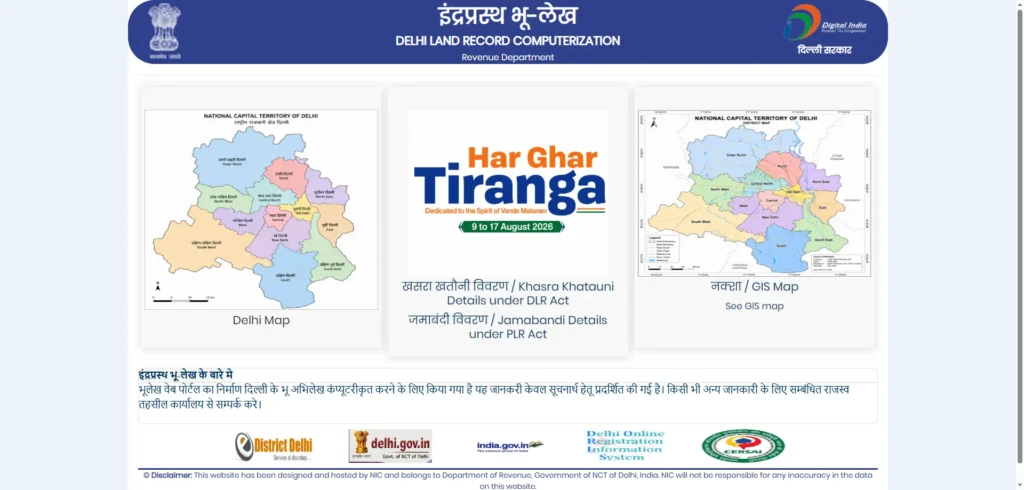
- Step 1: Open your web browser and go to the official DLRC portal at
https://dlrc.delhi.gov.in/. - Step 2: On the homepage, select “Khasra Khatauni Details”.
- Step 3: You will see a list of Delhi’s districts. Locate your district and click the “View Records” button next to it.
- Step 4: A search console will open. Use the dropdown menus to select your specific District, Subdivision, Village, and Khata Type.
- Step 5: Under the search options, select the “By Name” option.
- Step 6: A text field will appear. Enter the owner’s name exactly as it is spelled in the official sale deed.
- Step 7: Click “View Khata Details”. The portal will instantly display the Record of Rights (ROR) matching that name.
Checking ROR Reports by Khasra or Khata Number
If you already have the specific survey numbers from your property papers, you can retrieve the ROR directly.
- Step 1: Log on to the DLRC portal and navigate to the “Khasra Khatauni Details” page.
- Step 2: Select your district and click “View Records”.
- Step 3: Enter the District, Subdivision, Village, and Khata Type.
- Step 4: Select either “By Khata No.” or “By Khasra No.” depending on what details you have.
- Step 5: Enter the unique Khata or Khasra number into the search field and click “Proceed”.
- Step 6: Click on “View Khata Details” to pull up the authenticated ROR on your screen.
Visualizing Land Boundaries with GIS Maps on Bhulekh Delhi
In a massive step forward for boundary dispute prevention, the Delhi government integrated high-resolution Geographic Information System (GIS) cadastral maps directly into the Bhulekh portal. This allows land owners to visually verify their plot boundaries.
- Step 1: Visit
https://dlrc.delhi.gov.in/. - Step 2: On the map interface, click the “See GIS Map” button.
- Step 3: You will be redirected to a spatial mapping screen developed by Geospatial Delhi Limited.
- Step 4: Click on the “Khasra Information” tab located at the top of the map viewer.
- Step 5: A sidebar will open. Fill in your geographic details, including State, District, Division, Village, and Rectangle.
- Step 6: Click “View Ownership Details”. The map will zoom in, displaying a high-resolution overlay of the physical land boundaries mapped directly to your Khasra survey number.
Competitor Analysis & Search Authority: Why Most Portals Fall Short
If you have researched land records on the web before, you have likely noticed that many real estate blogs provide outdated, circular information. Many sites still direct readers to the old DORIS portal for new registrations, completely missing the fact that all 22 Sub-Registrar offices migrated to the national NGDRS system in early 2025. Others gloss over the complex divisions between DDA leaseholds, municipal freeholds, and Lal Dora lands, leaving buyers exposed to legal risks.
This guide stands apart by integrating direct legal directives from the Delhi Revenue Department, the MCD Unified Policy, and the DDA Mutation Handbooks.
The Property Mutation (Dakhil Kharij) Process in Delhi
A common and highly risky mistake made by property buyers in Delhi is assuming that registering their sale deed at the Sub-Registrar Office (SRO) completes their ownership transfer. It does not.
While deed registration transfers the legal title, it does not update the databases of local municipal and tax authorities. To ensure that your property tax bills, utility connections, and municipal records are officially updated in your name, you must complete the Property Mutation (locally known as Dakhil Kharij) process.
Where to Apply for Mutation in Delhi?
Applying for mutation at the wrong office can delay your application by weeks. The correct authority depends entirely on who owns the underlying land of your property:
- MCD (Municipal Corporation of Delhi): For freehold residential and commercial properties, municipal apartments, and approved colonies. Applications are submitted online at
mcdonline.nic.in. - DDA (Delhi Development Authority): For DDA allotted flats, DDA residential plots, and Self-Financing Schemes (SFS). Applications are processed online via
eservices.dda.org.in. - L&DO (Land & Development Office): For government-leased properties, institutional plots, and properties built on Nazul land (primarily in Lutyens’ Delhi). Applications are filed online at
ldo.gov.inbut require physical verification at the final stage. - Revenue Department / SDM: For agricultural land, rural zones, and Lal Dora properties. Applications must be submitted physically at the Tehsildar’s office in your local SDM jurisdiction.
Documents Required for a Smooth Mutation Process
To ensure that your mutation is processed within the standard 15 to 30 working days without rejection, you must upload clear, high-resolution PDF scans of the following documents:
Case A: Mutation After a standard Property Sale
- Registered Sale Deed: The primary proof of transaction.
- Latest Property Tax Clearance Receipt: Proof that all outstanding property tax dues for the last 5 years have been fully cleared.
- Indemnity Bond: Duly notarized on ₹100 stamp paper (Annexure B), indemnifying the municipal corporation against any future ownership disputes.
- Affidavit: Notarized on ₹10 stamp paper (Annexure C), declaring a clear, dispute-free transfer of title.
- Undertaking Form: Attested on ₹10 stamp paper, signed by the transferee.
- Identity Proofs: Copy of Aadhaar Card and PAN Card of the new owner.
- Prescribed Fees: Payment of ₹100 apportionment fee and ₹50 composition fee.
Case B: Mutation in Inheritance Cases (Owner Demise)
If the property is being mutated to legal heirs, you must submit these additional papers:
- Original Death Certificate of the registered owner.
- Certified Copy of the Will (or a Succession Certificate if the owner died intestate).
- Surviving Member Certificate (SMC): Issued by the local Revenue Department to establish the legal heirs.
- Relinquishment Deed: If some legal heirs are giving up their share in favor of another heir, a registered relinquishment deed must be provided.
Lal Dora Villages and the SVAMITVA Scheme in Delhi
No discussion on Delhi’s land records is complete without addressing Lal Dora land.
Historically, during British rule in 1908, the boundaries of rural residential areas (Abadi) were marked on maps with a red line—the Lal Dora—to separate village habitations from the surrounding agricultural fields. To support rural livelihoods, these areas were exempt from municipal building bylaws and standard property registration rules.
Over the decades, however, this exemption turned into a double-edged sword. It allowed unchecked construction, but left residents with no formal, authenticated ownership records. Because traditional title deeds do not exist for many Lal Dora properties, standard banks largely refuse home loans, and buyers face severe legal risks, including potential demolition orders from MCD or the courts.
How the SVAMITVA Scheme is Changing Lal Dora Land Management
To bring these historical settlements into the formal economy, the central government launched the SVAMITVA (Survey of Villages Abadi and Mapping with Improvised Technology in Village Areas) scheme. Managed in partnership with the Survey of India, this program uses high-resolution drone mapping and GIS technology to create precise digital records for Lal Dora properties.
The progress of this digital mapping has been meticulously tracked:
- Survey Scope: Across Delhi’s South and North West districts, the pilot survey completed mapping for 12,232 properties (polygons) across 48 rural villages.
- Dispute Resolution: Out of these, 8,423 properties (approximately 69%) were verified as completely dispute-free and certified for title issuance.
- Target: The remaining properties are undergoing dispute resolution, after which smart cards will be distributed directly to verified occupiers.
What is Included on the Smart QR Property Card?
The end product of the SVAMITVA survey is a digitally verified Smart Property Card. This card acts as a definitive proof of ownership, allowing residents to finally access bank credit and transfer titles safely.
Each smart card contains the following information:
- Unique Property Identification Number (PID).
- Bhu-Aadhaar Number (a 14-digit Unique Land Parcel Identification Number or ULPIN mapped via GPS).
- Occupant Name and share in the property.
- Precise Area Measurements (both built-up and open area).
- Official Digital Seal and Tehsildar’s signature.
By scanning the printed QR code, owners can open their Digital Form-13, which displays a cadastral sketch showing the property’s exact boundaries, neighboring plot IDs, and co-occupant details, fully secured under the Delhi Abadi Deh Survey and Record Management Rules, 2025.
The Future: Delhi Property Aadhaar Card & Land Records Bill 2026
The most significant reform on Delhi’s real estate horizon is the proposed Delhi Land Records Bill, 2026, championed by Chief Minister Rekha Gupta.
Currently, property records in the capital are fragmented across multiple agencies. For instance, government asset registries alone map over 16,000 properties across 60 departments (including MCD, DDA, and the Public Works Department) via the Delhi Asset Management Information System (DAMIS).
The new Bill aims to consolidate these scattered records under a single authority.
Key Changes Proposed Under the Land Records Bill 2026
- Floor-by-Floor Multi-Story Mapping: Existing land registries only map ground coordinates, creating massive legal confusion in multi-story apartment buildings. Under the 2026 Bill, a comprehensive scientific drone and aerial survey will create a distinct digital record for every single floor of every building across the NCT.
- Unique Property ID (UPID): Just as citizen Aadhaar cards provide a trusted personal identity, every real estate asset in the city will receive a secure digital identity via a Property Aadhaar Card.
- Integration with the Family Card Database: To streamline city governance, the Property Aadhaar database will link directly with Delhi’s Family Card database (which contains household demographics, occupations, and welfare enrollments). If you sell a property, the transaction will automatically update both your Property Aadhaar Card and your Family Card. This integration helps banks run automated due diligence, reduces tax evasion, and simplifies welfare delivery.
Important Terms to Know
Navigating land records is much easier once you understand the standard terminology used in official documents:
- ROR (Record of Rights): The master digital register containing the complete legal description of a land parcel, its owner, and active bank encumbrances.
- Khewat/Khata Number: A unique account identifier assigned to a landowner (or a group of co-owners), showcasing their complete portfolio of properties in a specific village or revenue circle.
- Khasra Number: A unique plot survey number assigned to a specific parcel of land in rural and urban areas, helping pinpoint its location on the official cadastral maps.
- Khatauni: A detailed revenue ledger that lists all the land parcels owned by a specific individual, serving as their consolidated proof of landholding.
- Dakhil Kharij (Property Mutation): The formal administrative process of transferring the name of the new owner into local municipal and tax registers.
- Bhu-Aadhaar (ULPIN): A unique 14-digit identification number assigned to a plot of land based on its exact GPS coordinates.
- DAMIS: The Delhi Asset Management Information System, a GIS-enabled digital repository used to map and secure all government-owned lands in the capital.
Navigating Delhi’s Digital Land Records Securely
The digitization of Delhi’s land records through the DLRC (Bhulekh), NGDRS, and MCD portals represents a massive leap forward in transparency, security, and convenience. By taking advantage of these online platforms, you can verify property ownership, check boundaries, and protect your real estate investments from the comfort of your home.
However, because Delhi’s properties are split across different jurisdictions (freehold, DDA leasehold, and Lal Dora), you must make sure you utilize the correct portal for your specific property type. Always double-check your records across both registration and revenue databases, and verify that your property mutation is fully completed after registration to ensure a clear, dispute-free title.