
The year 2026 represents a historic pivot in the Indian real estate sector, particularly within Andhra Pradesh. For over a century, property transactions in India were governed by the Registration Act of 1908, a colonial-era framework that often struggled to provide the transparency required in a modern digital economy. This era has officially ended with the introduction of the Registration Bill, 2025, a landmark piece of legislation that facilitates a “presence-less” digital registration environment.
As an expert consultant in land governance, I have observed that the most profound shift is the transition from “presumptive” titles to “conclusive” ownership. Under the old regime, a land record was merely a presumption of title, often leading to protracted litigation. Today, through the Digital India Land Records Modernisation Programme (DILRMP), which has achieved a 95% saturation rate across rural India, the state-guaranteed digital record acts as the final authority. This guide provides a comprehensive overview of the Meebhoomi AP ecosystem, covering the Adangal download process, ROR-1B verification, and the cutting-edge Mee Bhoomi Blockchain integration.
Consultant Strategic Note: For legal professionals and investors, this revolution means that the “traumatic” nature of property acquisition—as described by the judiciary—is being replaced by a system where the “single source of truth” is just a few clicks away. The integration with the National Generic Document Registration System (NGDRS) ensures that Andhra Pradesh is a leader in the “One Nation, One Registration” framework.
Understanding Meebhoomi AP: The Digital Core of Andhra Pradesh
Launched by the Government of Andhra Pradesh to manage the state’s vast revenue data, Meebhoomi AP (meaning “Your Land” in Telugu) is the primary digital repository for all land-related transactions. Managed by the Revenue Department, the portal has evolved from a simple viewing tool into a sophisticated management system integrated with Webland 1.0 and the APCRDA 2.0 framework.
The system is designed to provide a corruption-free, economical administration of land records. It integrates data from the revenue, survey, and registration departments to eliminate the discrepancies that historically fueled boundary disputes. By 2026, the portal is fully synchronised with Aadhaar authentication, ensuring that every modification to a record is both authorised and auditable.
Core Services Available in 2026
The following services are available to citizens and legal practitioners through the centralised dashboard:
- Adangal / Village Adangal: Real-time accounts of land use and seasonal cultivation.
- ROR 1-B / Gram 1-B: The official Record of Rights for individuals and entire villages.
- FMB (Field Measurement Book): Technical sketches of land parcels with precise measurements.
- LP Maps (Land Parcel Maps): Visual representations for areas that have undergone the modern re-survey.
- Survey Number Dispute Register: A public log identifying parcels currently under litigation.
- Electronic Passbook (e-Passbook): A secure digital version of the traditional Pattadar Passbook.
- Land Conversion Details: Proof of official transition from agricultural to non-agricultural use.
- Mutation Tracking: A real-time monitor for ownership changes and record corrections.
Deciphering Key Documents: Adangal vs ROR-1B
In my practice, the most common source of confusion for clients is the distinction between the Adangal and the Record of Rights (ROR-1B). While both are critical AP land records, they serve distinct administrative purposes.
Comparison Table: Meebhoomi Adangal vs ROR-1B
| Aspect | Meebhoomi Adangal (Pahani) | ROR-1B (Record of Rights) |
| Primary Purpose | Records agricultural usage and possession. | Confirms legal ownership and title. |
| Source of Origin | Digitised from Village Count Number 3. | Sourced from manual registers (pre-digitisation). |
| Key Details | Soil type, crops grown, water source, and tenancy. | Owner’s name, Khata number, and ownership history. |
| Maintaining Authority | Village Revenue Officer (VRO). | Tehsildar / Revenue Department. |
| Primary Usage | Crop insurance, PM-Kisan, and farming loans. | Property sales, mortgages, and court evidence. |
| Update Frequency | Seasonally updated based on crop patterns. | Updated only via Mutation (ownership change). |
| Legal Weight | Admissible evidence of possession. | Conclusive proof of title/title extract. |
The Electronic Passbook (e-Passbook)
The e-Passbook acts as a consolidated digital summary. It includes the Pattadar name, the Title Deed number, and total land extent. In the 2026 landscape, the e-Passbook is the gold standard for bank KYC and identity verification during property transfers.
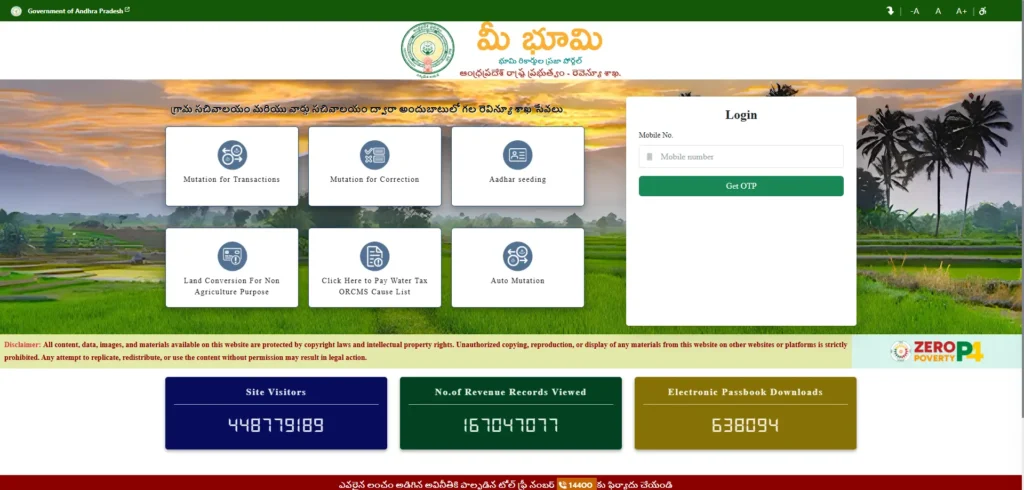
Step-by-Step Guide: Accessing and Downloading Records
The Meebhoomi AP portal has been optimised for 2026 with a high-speed interface. Below are the verified protocols for record retrieval.
How to Perform an Adangal Download
To access your personal land use details or the village-wide record, follow this 8-step process:
- Visit the official portal at meebhoomi.ap.gov.in.
- Navigate to the “Your Adangal/Village Adangal” tab on the main menu.
- Choose between “Personal Adangal” or “Village Adangal”.
- Select your District, Mandal, and Village from the drop-down lists.
- Search using your preferred vector: Survey Number, Khata (Account) Number, Aadhaar Number, or Pattadar Name.
- Consultant Note: You may also search using the Adaru number or Auto Mutation Records for parcels recently processed.
- Enter the 5-digit security captcha code accurately.
- Click “Submit” to view the record. Use the “Print” option or “Download PDF” to save the Adangal download for your archives.
How to Access ROR-1B (Gram 1-B)
- Select the “1-B” option from the homepage.
- Provide the mandatory regional identifiers (District, Mandal, Village).
- Search by Khata number or Pattadar name.
- Verify the ownership history and current status.
- Download the document, which is mandatory for all Title Verification reports.
Viewing Village Maps and FMB
For boundary verification, the portal offers two distinct visual tools:
- Field Measurement Book (FMB): These are traditional sketches showing survey boundaries and plot dimensions. They are essential for resolving local boundary disputes.
- LP Maps (Land Parcel Maps): These are modern, digital maps available specifically for parcels in mandals where the re-survey is complete.
- NAKSHA (Urban Mapping): For the 150 cities included in the NAKSHA pilot, users can now view 3D boundary mappings to handle vertical growth and apartment-level disputes.
Bhu-Aadhar (ULPIN): The 14-Digit Security Shield
A cornerstone of the 2026 land registry revolution is Bhu-Aadhar, formally known as the Unique Land Parcel Identification Number (ULPIN).
What is ULPIN?
The ULPIN is a 14-digit alphanumeric code assigned to every land parcel. It is generated using the precise geo-coordinates of the parcel’s boundaries. This essentially gives every piece of land in Andhra Pradesh a unique digital fingerprint.
Consultant Strategic Insight: Why Demand ULPIN?
As a strategist, I advise all buyers to demand a ULPIN-linked deed. In the legacy system, “double-selling” was a common fraud where a seller sold the same plot to multiple buyers. With Bhu-Aadhar, the NGDRS automatically flags any attempt to register a new transaction against coordinates that are already part of an active transaction.
ULPIN Benefits Checklist:
- Instant History: Verify the chain of custody from 1981 to 2026.
- Boundary Precision: Eliminates “encroachment anxiety” through satellite-verified mapping.
- e-Court Integration: The system highlights active “stay orders” or litigation from the judicial database immediately.
Innovation Spotlight: Mee Bhoomi Blockchain & AI
Andhra Pradesh has set a global benchmark by launching the Mee Bhoomi-Blockchain pilot project. Developed in collaboration with the National Informatics Centre (NIC) Andhra Pradesh and the Centre of Excellence in Blockchain Technology at NIC Bengaluru, this system uses Hyperledger Fabric technology.
The Immutable Ledger
The blockchain creates a timestamped, tamper-proof record of ownership. Unlike traditional databases, where a rogue official might backdate a record, the Mee Bhoomi-Blockchain ensures that once an entry is made, it cannot be altered without leaving a permanent audit trail of the official’s identity and the exact time.
Pilot Mandals (2026 Implementation):
The project is currently live in seven strategic mandals:
- Aspari (Kurnool)
- Penumuru (Chittoor)
- Repalle (Bapatla)
- Gannavaram (Krishna)
- Kadiyam (East Godavari)
- Gummalakshmipuram (Parvathipuram Manyam)
- Kothavalasa (Vizianagaram)
Administrative Procedures: Mutations and Aadhaar Linking
Land Mutation & Record Corrections
Mutation is the process of updating the ROR-1B after a sale or inheritance. In 2026, the Meebhoomi portal allows users to track the status of Mutation Applications in real-time. If you find an incorrect landowner name, survey number error, or discrepancy in usage type, you must file a correction request immediately. The Supreme Court’s quashing of restrictive mutation proof rules in Bihar (2025) has streamlined this across several states, ensuring Registrars cannot create unnecessary hurdles for legitimate sellers.
Aadhaar and Mobile Number Linking
Linking your Aadhaar and Mobile Number to your land record is mandatory for:
- Security: Receiving SMS alerts for any attempted modification to your record.
- Benefits: Receiving funds from PM-Kisan and Annadatha Sukhibhava.
- Identity: Verification of the Pattadar during the generation of digital Title Deeds.
Users can check their status under the “Aadhaar/Other Identities” tab. If unlinked, a visit to a MeeSeva centre or the Tahsildar’s office with a registered mobile number is required.
Fees, Charges, and Certified Copies (2026)
While viewing records on the Meebhoomi AP portal is free for personal reference, Certified Copies (required for bank loans and legal registration) attract a fee. These are typically obtained via MeeSeva or the Grama Sachivalayam.
Service Charges Table (2026)
| Service Type | Official Fee (INR) |
| Certified Copy of ROR-1B | ₹40 |
| Certified Adangal / Pahani | ₹40 |
| Certified FMB / LP Map | ₹40 |
| Mutation Application | ₹150 |
| Adangal Corrections | ₹35 |
| Electronic Passbook | Government Fixed Rate |
| Aadhaar Linking | Free |
| Online Record Viewing | Free |
Consultant Tip: Always distinguish between a “digitally unsigned” copy (free, for reference) and a “certified copy” (paid, legally binding). For any property transaction, only a certified copy with the Sub-registrar’s seal is valid.
Troubleshooting: Handling Disputes and Filing Complaints
In 2026, the grievance redressal mechanism is integrated directly into the portal. If you face missing land records, boundary disputes, or delay in land mutation, follow this protocol:
Filing a Grievance:
- Go to the “Complaints” section on the Meebhoomi homepage.
- Select the specific issue (e.g., Ownership Error, Survey Discrepancy).
- Enter your District, Mandal, Village, and Survey Number.
- Upload supporting documents such as old Adangal records or the Sale Deed.
- Note the Unique Reference Number for tracking.
Official Contact Data:
- Helpline Number: 14400 (Toll-free technical assistance).
- Official Email: meebhoomi-ap@gov.in or ccla-as-cmro@ap.gov.in.
- Physical Address: The Chief Commissioner of Land Administration, APIIC Towers, IT Park, Auto Nagar, Mangalagiri, 522503.
Conclusion: The Future of Trust in AP Real Estate
The Meebhoomi AP 2026 framework has successfully moved Andhra Pradesh from a broken, paper-based system to a streamlined, digital-first nation. By implementing Bhu-Aadhar (ULPIN), NGDRS, and Hyperledger Fabric blockchain, the state has restored trust in property ownership.
For legal professionals, this means a shift from manual ledger searches to strategic advice. For the citizen, it provides a “security shield” against the property frauds of the past. As a final expert tip: verify your land records quarterly. Frequent checks of your Adangal and ROR-1B status on the Meebhoomi portal ensure that your most valuable asset remains secure from unauthorised changes. The era of the “traumatic” property purchase is over; the era of digital certainty has arrived.